Heliophysics

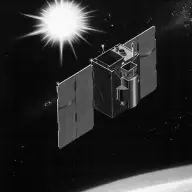
Solar Anomalous and Magnetospheric Particle Explorer (SAMPEX)

In-Situ Probe · Competed · Agency-led · Launched on July 3, 1992 · Completed · LCC: $50M/$128M (2025 $)Life-cycle cost: NASA’s reported cost to build, launch, and operate a mission through its prime mission, plus documented partner contributions, in 2025 dollars. Extended missions are not included. Methods · Wikipedia

Scope Active Mission WindowActivePapers published from the first full month after science operations begin through two years after the mission ends. Citations are counted through the third calendar year after each paper appears. For SAMPEX, papers published November 1, 1992 to July 1, 2006. Methods LifetimeLifetimeEvery tracked publication to date, with every citation to date. For SAMPEX, papers published from 1993 to November 3, 2026. Methods
Tracked publicationsTracked publications: peer-reviewed papers we found that name the mission or its instruments in their titles, abstracts, or keywords. Papers that used the data without naming it are missed. Methods214
CitationsCitations: every citation these publications have drawn to date. Older missions have had longer to collect them. Methods9,531
Citation indices
h-indexh-index: the largest h such that h papers have at least h citations each. It only grows with time, so older missions score higher. Methods56
g-indexg-index: the largest g for which the g most-cited papers together hold at least g² citations. Like the h-index, but it lets the most-cited papers count for more. Methods90
m-indexm-index: a mission’s h-index divided by the years since its first peer-reviewed paper. It falls every 1 January even when nothing else changes; the figure shown is as of November 3, 2026. It also discounts the long operating life that larger missions paid for. Methods1.6
toritori (total research impact, from SciX): for every paper citing one of the mission’s papers, 1 divided by the citing paper’s reference count times the cited paper’s author count, summed, with self-citations removed. It favors citations from papers with short reference lists and from outside the mission’s own authors. Computed over the tracked citation graph, which can be slightly incomplete. Always over every tracked publication to date, whichever scope is chosen. Methods60
riqriq (research impact quotient): 1,000 times the square root of tori, divided by the years since the mission’s first paper. A rate, not a total, so it does not keep growing with age the way the h-index and tori do. Like tori, always over every tracked publication to date. Methods227

Publications and citations by year (lifetime)

Publications per yearCumulative citations

Institutional contributions (lifetime)The institutions SciX lists for each paper’s authors, as printed on the paper, located through the Research Organization Registry. A square counts a paper once, however many of its authors worked there. Methods

Loading the map…

Tracked publications over the lifetime (214)

All publications CSV · JSON

  1. Outward radial diffusion driven by losses at magnetopause

    Shprits, Y. Y., 2006, JGRA

    337 lifetime citations

  2. Timescale for MeV electron microburst loss during geomagnetic storms

    Thorne, R. M., 2005, JGRA

    306 lifetime citations

  3. Relativistic electron acceleration and precipitation during resonant interactions with whistler-mode chorus

    Horne, R. B., 2003, GeoRL

    263 lifetime citations

  4. Multisatellite observations of the outer zone electron variation during the November 3-4, 1993, magnetic storm

    Li, Xinlin, 1997, JGR

    258 lifetime citations

  5. Slot region electron loss timescales due to plasmaspheric hiss and lightning-generated whistlers

    Meredith, Nigel P., 2007, JGRA

    243 lifetime citations

  6. Observations of relativistic electron microbursts in association with VLF chorus

    Lorentzen, K. R., 2001, JGR

    231 lifetime citations

  7. Energization of relativistic electrons in the presence of ULF power and MeV microbursts: Evidence for dual ULF and VLF acceleration

    O'Brien, T. P., 2003, JGRA

    231 lifetime citations

  8. On the origin of relativistic electrons in the magnetosphere associated with some geomagnetic storms

    Rostoker, Gordon, 1998, GeoRL

    218 lifetime citations

  9. Relativistic electron acceleration and decay time scales in the inner and outer radiation belts: SAMPEX

    Baker, D. N., 1994, GeoRL

    216 lifetime citations

  10. An overview of the Solar, Anomalous, and Magnetospheric Particle Explorer (SAMPEX) mission

    Baker, Daniel N., 1993, ITGRS

    209 lifetime citations

  11. Energy Spectra, Composition, and Other Properties of Ground-Level Events During Solar Cycle 23

    Mewaldt, R. A., 2012, SSRv

    176 lifetime citations

  12. Observation of two distinct, rapid loss mechanisms during the 20 November 2003 radiation belt dropout event

    Bortnik, J., 2006, JGRA

    170 lifetime citations

  13. Proton, helium, and electron spectra during the large solar particle events of October-November 2003

    Mewaldt, R. A., 2005, JGRA

    167 lifetime citations

  14. Relativistic electron loss timescales in the slot region

    Meredith, Nigel P., 2009, JGRA

    152 lifetime citations

  15. Long term measurements of radiation belts by SAMPEX and their variations

    Li, Xinlin, 2001, GeoRL

    150 lifetime citations

  16. Radiation Belt Environment model: Application to space weather nowcasting

    Fok, Mei-Ching, 2008, JGRA

    134 lifetime citations

  17. Coronal mass ejections, magnetic clouds, and relativistic magnetospheric electron events: ISTP

    Baker, D. N., 1998, JGR

    131 lifetime citations

  18. Space weather conditions and spacecraft anomalies in different orbits

    Iucci, N., 2005, SpWea

    120 lifetime citations

  19. Competing source and loss mechanisms due to wave-particle interactions in Earth's outer radiation belt during the 30 September to 3 October 2012 geomagnetic storm

    Turner, D. L., 2014, JGRA

    114 lifetime citations

  20. A strong CME-related magnetic cloud interaction with the Earth's Magnetosphere: ISTP observations of rapid relativistic electron acceleration on May 15, 1997

    Baker, D. N., 1998, GeoRL

    111 lifetime citations

How we found these papers

We searched NASA’s Science Explorer (SciX) for peer-reviewed articles naming SAMPEX in the title, abstract or keywords; standard filters drop articles that are not peer-reviewed and magazine pieces.

(((abs:SAMPEX AND abs:(particle OR particles OR electron OR electrons OR proton OR protons OR ion OR ions OR cosmic OR magnetosphere OR magnetospheric OR radiation OR spacecraft OR satellite OR precipitation OR solar)) OR =abs:"Solar Anomalous and Magnetospheric Particle Explorer")) AND property:refereed AND doctype:article AND pubdate:[1992-11 TO 2040-01] AND NOT bibstem:("A&R" OR "ACPD" OR "AIASJ" OR "AMTD" OR "AeAm" OR "AirSp" OR "AsNow" OR "AsUAI" OR "AvWST" OR "BGD" OR "C&E" OR "C&T" OR "CAPJ" OR "CliPD" OR "E&S" OR "ENews" OR "ESDD" OR "ESSDD" OR "ESuDD" OR "GID" OR "GMDD" OR "GeCAS" OR "HESSD" OR "IrAJ" OR "JCos" OR "JRASC" OR "LAstr" OR "MNSSA" OR "Met" OR "NHESD" OR "NPGD" OR "NewSc" OR "OcScD" OR "Orion" OR "PhT" OR "PhTea" OR "PhuZ" OR "PhyOJ" OR "PhyW" OR "PlR" OR "SOILD" OR "SciAm" OR "SpFl" OR "TCD" OR "ZemVs")

Open in SciX

Removed after review (5)

  1. Near-Earth radiation environment including time variations and secondary radiation. Proceedings. Meetings F2.6 and F2.7 of COSPAR Scientific Commission F which was held during the Thirtieth COSPAR Scientific Assembly, Hamburg (Germany), 11 - 12 Jul 1994. Proceedings volume record listing session topics; its papers are indexed separately. Decision 🤖
  2. Radiation Belts: Models and Standards Book volume record with a jacket summary; its chapters are indexed separately. Decision 🤖
  3. Preface Editorial preface to a book volume; not a research paper. Decision 🤖
  4. The FIREBIRD-II CubeSat mission: Focused investigations of relativistic electron burst intensity, range, and dynamics Overview of the FIREBIRD-II CubeSat mission; mentions SAMPEX only for comparison. Decision 🤖
  5. The Energetic Particles: Acceleration, Composition, and Transport (EPACT) investigation on the WIND spacecraft Instrument description of the Wind EPACT investigation; a different mission. Decision 🤖