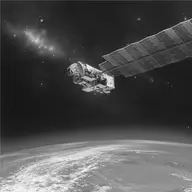
Earth Science

Aura

Orbiter · Directed · Agency-led · Launched on July 15, 2004 · Extended Mission · LCC: $905M/$1.9B (2025 $)Life-cycle cost: NASA’s reported cost to build, launch, and operate a mission through its prime mission, plus documented partner contributions, in 2025 dollars. Extended missions are not included. Methods · Wikipedia

Scope Active Mission WindowActivePapers published from the first full month after science operations begin through two years after the mission ends. Citations are counted through the third calendar year after each paper appears. For Aura, papers published September 1, 2004 to January 1, 2024. Methods LifetimeLifetimeEvery tracked publication to date, with every citation to date. For Aura, papers published from 2004 to November 3, 2026. Methods
Tracked publicationsTracked publications: peer-reviewed papers we found that name the mission or its instruments in their titles, abstracts, or keywords. Papers that used the data without naming it are missed. Methods2,975
CitationsCitations: every citation these publications have drawn to date. Older missions have had longer to collect them. Methods100,603
Citation indices
h-indexh-index: the largest h such that h papers have at least h citations each. It only grows with time, so older missions score higher. Methods133
g-indexg-index: the largest g for which the g most-cited papers together hold at least g² citations. Like the h-index, but it lets the most-cited papers count for more. Methods196
m-indexm-index: a mission’s h-index divided by the years since its first peer-reviewed paper. It falls every 1 January even when nothing else changes; the figure shown is as of November 3, 2026. It also discounts the long operating life that larger missions paid for. Methods5.8
toritori (total research impact, from SciX): for every paper citing one of the mission’s papers, 1 divided by the citing paper’s reference count times the cited paper’s author count, summed, with self-citations removed. It favors citations from papers with short reference lists and from outside the mission’s own authors. Computed over the tracked citation graph, which can be slightly incomplete. Always over every tracked publication to date, whichever scope is chosen. Methods382
riqriq (research impact quotient): 1,000 times the square root of tori, divided by the years since the mission’s first paper. A rate, not a total, so it does not keep growing with age the way the h-index and tori do. Like tori, always over every tracked publication to date. Methods814

Publications and citations by year (lifetime)

Publications per yearCumulative citations

Institutional contributions (lifetime)The institutions SciX lists for each paper’s authors, as printed on the paper, located through the Research Organization Registry. A square counts a paper once, however many of its authors worked there. Methods

Loading the map…

Tracked publications over the lifetime (2,975)

All publications CSV · JSON

  1. The Ozone Monitoring Instrument

    Levelt, Pieternel F., 2006, ITGRS

    1,458 lifetime citations

  2. The Earth Observing System Microwave Limb Sounder (EOS MLS) on the Aura Satellite

    Waters, Joe W., 2006, ITGRS

    1,033 lifetime citations

  3. Aerosols and surface UV products from Ozone Monitoring Instrument observations: An overview

    Torres, Omar, 2007, JGRD

    584 lifetime citations

  4. Aura OMI observations of regional SO₂ and NO₂ pollution changes from 2005 to 2015

    Krotkov, Nickolay A., 2016, ACP

    557 lifetime citations

  5. Absorption Angstrom Exponent in AERONET and related data as an indicator of aerosol composition

    Russell, P. B., 2010, ACP

    543 lifetime citations

  6. Evaluation of black carbon estimations in global aerosol models

    Koch, D., 2009, ACP

    478 lifetime citations

  7. An improved tropospheric NO₂ column retrieval algorithm for the Ozone Monitoring Instrument

    Boersma, K. F., 2011, AMT

    445 lifetime citations

  8. Impact of Coronavirus Outbreak on NO₂ Pollution Assessed Using TROPOMI and OMI Observations

    Bauwens, M., 2020, GeoRL

    436 lifetime citations

  9. Steps towards a mechanistic model of global soil nitric oxide emissions: implementation and space based-constraints

    Hudman, R. C., 2012, ACP

    404 lifetime citations

  10. Near-real time retrieval of tropospheric NO₂ from OMI

    Boersma, K. F., 2007, ACP

    390 lifetime citations

  11. Application of OMI observations to a space-based indicator of NO ₓ and VOC controls on surface ozone formation

    Duncan, Bryan N., 2010, AtmEn

    383 lifetime citations

  12. Importance of rain evaporation and continental convection in the tropical water cycle

    Worden, John, 2007, Natur

    363 lifetime citations

  13. Science Objectives of the Ozone Monitoring Instrument

    Levelt, Pieternel F., 2006, ITGRS

    356 lifetime citations

  14. Spatial and temporal variability of ozone sensitivity over China observed from the Ozone Monitoring Instrument

    Jin, Xiaomeng, 2015, JGRD

    349 lifetime citations

  15. Validation of the Aura Microwave Limb Sounder temperature and geopotential height measurements

    Schwartz, M. J., 2008, JGRD

    347 lifetime citations

  16. Aura Microwave Limb Sounder observations of dynamics and transport during the record-breaking 2009 Arctic stratospheric major warming

    Manney, Gloria L., 2009, GeoRL

    344 lifetime citations

  17. Why do models overestimate surface ozone in the Southeast United States?

    Travis, Katherine R., 2016, ACP

    338 lifetime citations

  18. A space-based, high-resolution view of notable changes in urban NOₓ pollution around the world (2005-2014)

    Duncan, Bryan N., 2016, JGRD

    334 lifetime citations

  19. The Ozone Monitoring Instrument: overview of 14 years in space

    Levelt, Pieternel F., 2018, ACP

    331 lifetime citations

  20. Cloud ice: A climate model challenge with signs and expectations of progress

    Waliser, Duane E., 2009, JGRD

    320 lifetime citations

How we found these papers

We searched NASA’s Science Explorer (SciX) for peer-reviewed articles naming Aura in the title, abstract or keywords; standard filters drop articles that are not peer-reviewed and magazine pieces.

(((abs:Aura AND abs:(HIRDLS OR MLS OR OMI OR TES OR satellite OR spacecraft OR ozone OR stratospher* OR tropospher* OR ="remote sensing")) OR =abs:"Aura Earth-Observing" OR =abs:"EOS Aura" OR =abs:"eos-ch1" OR =abs:"EOS CH-1" OR =abs:"eos-chem1" OR =abs:"High Resolution Dynamics Limb Sounder" OR (=abs:"Ozone Monitoring Instrument" AND NOT ((=abs:"Global Ozone Monitoring Instrument" OR =abs:"Tropospheric Ozone Monitoring Instrument") AND NOT abs:OMI)) OR =abs:"Tropospheric Emission Spectrometer" OR (abs:HIRDLS AND abs:(stratospher* OR ozone OR temperature OR satellite OR atmospheric)) OR (abs:OMI AND abs:(ozone OR ="nitrogen dioxide" OR NO2 OR SO2 OR aerosol* OR ="sulfur dioxide")) OR ((abs:MLS OR =abs:"Microwave Limb Sounder") AND abs:(Aura OR EOS))) AND NOT =abs:"AURA Inc." AND NOT =abs:"Cathartes aura") AND property:refereed AND doctype:article AND pubdate:[2004-09 TO 2040-01] AND NOT bibstem:("A&R" OR "ACPD" OR "AIASJ" OR "AMTD" OR "AeAm" OR "AirSp" OR "AsNow" OR "AsUAI" OR "AvWST" OR "BGD" OR "C&E" OR "C&T" OR "CAPJ" OR "CliPD" OR "E&S" OR "ENews" OR "ESDD" OR "ESSDD" OR "ESuDD" OR "GID" OR "GMDD" OR "GeCAS" OR "HESSD" OR "IrAJ" OR "JCos" OR "JRASC" OR "LAstr" OR "MNSSA" OR "Met" OR "NHESD" OR "NPGD" OR "NewSc" OR "OcScD" OR "Orion" OR "PhT" OR "PhTea" OR "PhuZ" OR "PhyOJ" OR "PhyW" OR "PlR" OR "SOILD" OR "SciAm" OR "SpFl" OR "TCD" OR "ZemVs")

Open in SciX

Removed after review (1)

  1. TROPOMI on the ESA Sentinel-5 Precursor: A GMES mission for global observations of the atmospheric composition for climate, air quality and ozone layer applications Describes the Sentinel-5P/TROPOMI mission; mentions Aura's OMI only as design heritage. Decision 🤖