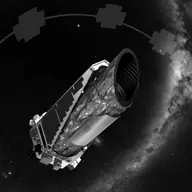
Astrophysics

Kepler

Survey Observatory · Competed · PI-led · Launched on March 6, 2009 · Completed · LCC: $692M/$1.1B (2025 $)Life-cycle cost: NASA’s reported cost to build, launch, and operate a mission through its prime mission, plus documented partner contributions, in 2025 dollars. Extended missions are not included. Methods · Wikipedia

Scope Active Mission WindowActivePapers published from the first full month after science operations begin through two years after the mission ends. Citations are counted through the third calendar year after each paper appears. For Kepler, papers published June 1, 2009 to November 1, 2020. Methods LifetimeLifetimeEvery tracked publication to date, with every citation to date. For Kepler, papers published from 2009 to November 3, 2026. Methods
Tracked publicationsTracked publications: peer-reviewed papers we found that name the mission or its instruments in their titles, abstracts, or keywords. Papers that used the data without naming it are missed. Methods4,596
CitationsCitations: every citation these publications have drawn to date. Older missions have had longer to collect them. Methods239,755
Citation indices
h-indexh-index: the largest h such that h papers have at least h citations each. It only grows with time, so older missions score higher. Methods206
g-indexg-index: the largest g for which the g most-cited papers together hold at least g² citations. Like the h-index, but it lets the most-cited papers count for more. Methods327
m-indexm-index: a mission’s h-index divided by the years since its first peer-reviewed paper. It falls every 1 January even when nothing else changes; the figure shown is as of November 3, 2026. It also discounts the long operating life that larger missions paid for. Methods11.4
toritori (total research impact, from SciX): for every paper citing one of the mission’s papers, 1 divided by the citing paper’s reference count times the cited paper’s author count, summed, with self-citations removed. It favors citations from papers with short reference lists and from outside the mission’s own authors. Computed over the tracked citation graph, which can be slightly incomplete. Always over every tracked publication to date, whichever scope is chosen. Methods870
riqriq (research impact quotient): 1,000 times the square root of tori, divided by the years since the mission’s first paper. A rate, not a total, so it does not keep growing with age the way the h-index and tori do. Like tori, always over every tracked publication to date. Methods1,551

Publications and citations by year (lifetime)

Publications per yearCumulative citations

Institutional contributions (lifetime)The institutions SciX lists for each paper’s authors, as printed on the paper, located through the Research Organization Registry. A square counts a paper once, however many of its authors worked there. Methods

Loading the map…

Tracked publications over the lifetime (4,596)

All publications CSV · JSON

  1. Kepler Planet-Detection Mission: Introduction and First Results

    Borucki, William J., 2010, Sci

    4,003 lifetime citations

  2. Modules for Experiments in Stellar Astrophysics (MESA): Planets, Oscillations, Rotation, and Massive Stars

    Paxton, Bill, 2013, ApJS

    3,774 lifetime citations

  3. The K2 Mission: Characterization and Early Results

    Howell, Steve B., 2014, PASP

    1,848 lifetime citations

  4. Habitable Zones around Main-sequence Stars: New Estimates

    Kopparapu, Ravi Kumar, 2013, ApJ

    1,428 lifetime citations

  5. The California-Kepler Survey. III. A Gap in the Radius Distribution of Small Planets

    Fulton, Benjamin J., 2017, AJ

    1,420 lifetime citations

  6. Kepler Mission Design, Realized Photometric Performance, and Early Science

    Koch, David G., 2010, ApJ

    1,176 lifetime citations

  7. Planet Occurrence within 0.25 AU of Solar-type Stars from Kepler

    Howard, Andrew W., 2012, ApJS

    1,107 lifetime citations

  8. The False Positive Rate of Kepler and the Occurrence of Planets

    Fressin, François, 2013, ApJ

    1,064 lifetime citations

  9. Planetary Candidates Observed by Kepler. III. Analysis of the First 16 Months of Data

    Batalha, Natalie M., 2013, ApJS

    1,050 lifetime citations

  10. Kepler Presearch Data Conditioning II - A Bayesian Approach to Systematic Error Correction

    Smith, Jeffrey C., 2012, PASP

    1,012 lifetime citations

  11. Fast and Scalable Gaussian Process Modeling with Applications to Astronomical Time Series

    Foreman-Mackey, Daniel, 2017, AJ

    1,003 lifetime citations

  12. The Occurrence of Potentially Habitable Planets Orbiting M Dwarfs Estimated from the Full Kepler Dataset and an Empirical Measurement of the Detection Sensitivity

    Dressing, Courtney D., 2015, ApJ

    998 lifetime citations

  13. Characteristics of Planetary Candidates Observed by Kepler. II. Analysis of the First Four Months of Data

    Borucki, William J., 2011, ApJ

    962 lifetime citations

  14. Kepler Presearch Data Conditioning I—Architecture and Algorithms for Error Correction in Kepler Light Curves

    Stumpe, Martin C., 2012, PASP

    883 lifetime citations

  15. The Evaporation Valley in the Kepler Planets

    Owen, James E., 2017, ApJ

    868 lifetime citations

  16. Kepler Planets: A Tale of Evaporation

    Owen, James E., 2013, ApJ

    861 lifetime citations

  17. The NASA Exoplanet Archive: Data and Tools for Exoplanet Research

    Akeson, R. L., 2013, PASP

    838 lifetime citations

  18. Kepler Input Catalog: Photometric Calibration and Stellar Classification

    Brown, Timothy M., 2011, AJ

    825 lifetime citations

  19. Rotation Periods of 34,030 Kepler Main-sequence Stars: The Full Autocorrelation Sample

    McQuillan, A., 2014, ApJS

    784 lifetime citations

  20. Architecture of Kepler's Multi-transiting Systems. II. New Investigations with Twice as Many Candidates

    Fabrycky, Daniel C., 2014, ApJ

    762 lifetime citations

How we found these papers

We searched NASA’s Science Explorer (SciX) for peer-reviewed articles naming Kepler in the title, abstract or keywords; standard filters drop articles that are not peer-reviewed and magazine pieces.

(((facility:"Kepler" OR (=abs:("Kepler mission"~2 OR "Kepler missions"~2 OR "Kepler spacecraft"~2 OR "Kepler satellite"~2 OR "Kepler telescope"~3 OR "Kepler photometry"~2 OR "Kepler data"~2 OR "Kepler observations"~2 OR "Kepler observed"~2 OR "Kepler light curve"~3 OR "Kepler light curves"~3 OR "Kepler targets"~2 OR "Kepler field"~2 OR "Kepler catalog"~3 OR "Kepler survey"~2 OR "Kepler candidates"~2 OR "Kepler sample"~2 OR "Kepler asteroseismology"~3 OR "Kepler asteroseismic"~3 OR "Kepler eclipsing"~2 OR "Kepler binary"~2 OR "Kepler binaries"~2))) OR facility:K2 OR abs:/kepler[0-9]+[a-z]?/ OR ((=abs:("K2 mission"~2 OR "K2 campaign"~3 OR "K2 data"~2 OR "K2 photometry"~2 OR "K2 light curve"~3 OR "K2 observations"~2 OR "K2 observed"~2 OR "K2 TESS"~3 OR "K2 b"~2 OR "K2 planet"~2 OR "K2 planets"~2) OR (abs:/k2[0-9]+[a-z]?/ AND abs:K2)) AND =abs:(star OR stars OR stellar OR planet OR planets OR planetary OR transit OR transits OR photometry OR asteroseismology OR "light curve" OR "light curves" OR Kepler OR EPIC))) AND NOT =abs:("Kepler supernova remnant"~3 OR "Kepler SNR")) AND property:refereed AND doctype:article AND pubdate:[2009-06 TO 2040-01] AND NOT bibstem:("A&R" OR "ACPD" OR "AIASJ" OR "AMTD" OR "AeAm" OR "AirSp" OR "AsNow" OR "AsUAI" OR "AvWST" OR "BGD" OR "C&E" OR "C&T" OR "CAPJ" OR "CliPD" OR "E&S" OR "ENews" OR "ESDD" OR "ESSDD" OR "ESuDD" OR "GID" OR "GMDD" OR "GeCAS" OR "HESSD" OR "IrAJ" OR "JCos" OR "JRASC" OR "LAstr" OR "MNSSA" OR "Met" OR "NHESD" OR "NPGD" OR "NewSc" OR "OcScD" OR "Orion" OR "PhT" OR "PhTea" OR "PhuZ" OR "PhyOJ" OR "PhyW" OR "PlR" OR "SOILD" OR "SciAm" OR "SpFl" OR "TCD" OR "ZemVs")

Open in SciX

Removed after review (2)

  1. Transiting exoplanets from the CoRoT space mission. VIII. CoRoT-7b: the first super-Earth with measured radius CoRoT discovery of the exoplanet CoRoT-7b; mentions Kepler only as a future mission. Decision 👨
  2. Transiting Exoplanet Survey Satellite (TESS) Mission description of TESS; mentions Kepler only as a predecessor. Decision 🤖