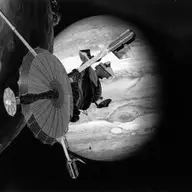
Galileo
1,577 tracked publications and 63,881 citations from 1991–2026. Launched 1989. Life-cycle cost: $4.6B in 2025 dollars. Active Mission Window January 1, 1996 to October 1, 2005: 797 publications, 42 top-10% credit.
Orbiter · h-index 115 · 152 papers with 100+ citations · prime mission ended 1997
Lifetime
Key measures
| Active Mission Window · papers January 1, 1996 to October 1, 2005 | |
|---|---|
| Tracked publications | 797 |
| Citations | 8,223 |
| Mean citations per publication | 10 |
| Median citations per publication | 6 |
| Uncited publications | 103 (13%) |
| Top-10% credit | 42 |
| Top-1% credit | 2 |
| Lifetime indices · every tracked publication to date, in any scope | |
|---|---|
| h-index | 115 |
| g-index | 168 |
| m-index, as of October 4, 2026 | 3.2 |
| tori | 431 |
| riq | 560 |
Tracked publications
Galileo Magnetometer Measurements: A Stronger Case for a Subsurface Ocean at Europa
529
Induced magnetic fields as evidence for subsurface oceans in Europa and Callisto
513
-
466
Evidence for a subsurface ocean on Europa
462
Energetic Ion and Electron Irradiation of the Icy Galilean Satellites
365
Europa's Differentiated Internal Structure: Inferences from Four Galileo Encounters
363
The Permanent and Inductive Magnetic Moments of Ganymede
363
Does Europa have a subsurface ocean? Evaluation of the geological evidence
360
Europa's Crust and Ocean: Origin, Composition, and the Prospects for Life
356
Geological evidence for solid-state convection in Europa's ice shell
348
Salts on Europa's Surface Detected by Galileo's Near Infrared Mapping Spectrometer
347
Discovery of Ganymede's magnetic field by the Galileo spacecraft
341
Subsurface Oceans on Europa and Callisto: Constraints from Galileo Magnetometer Observations
334
A search for life on Earth from the Galileo spacecraft
321
Sulfuric acid on Europa and the radiolytic sulfur cycle.
321
Jovian atmospheric dynamics: an update after Galileo and Cassini
299
Tectonic Processes on Europa: Tidal Stresses, Mechanical Response, and Visible Features
297
-
290
-
288
The composition of the Jovian atmosphere as determined by the Galileo probe mass spectrometer
283
How we found these papers
We searched NASA’s Astrophysics Data System (ADS) for peer-reviewed articles naming Galileo in the title, abstract or keywords; standard filters drop articles that are not peer-reviewed and magazine pieces. SciX is ADS’s current interface.
(((=abs:Galileo AND abs:(Jupiter OR Jovian OR Io OR Europa OR Ganymede OR Callisto OR Amalthea OR Thebe OR Gaspra OR Dactyl OR "Shoemaker-Levy" OR =abs:("Galilean satellites" OR "Galilean satellite" OR "Galilean moons" OR "Galilean moon")) NOT =abs:("Telescopio Nazionale Galileo" OR "Telescopio Nazinale Galileo")) OR (=abs:Galileo AND collection:astronomy AND (abs:(spacecraft OR flyby OR asteroid OR magnetometer) OR =abs:("entry probe" OR orbiter)) NOT (=abs:("navigation satellite" OR "satellite navigation" OR "positioning system" OR "Galileo Project" OR "Galileo FOC" OR "Galileo IOV" OR "Galileo constellation" OR "Galileo for Science" OR "Telescopio Nazionale Galileo" OR "Telescopio Nazinale Galileo") OR abs:(GLONASS OR BeiDou))) OR =abs:"Galileo probe" OR (collection:astronomy AND (=abs:("Near-Infrared Mapping Spectrometer" OR "Near Infrared Mapping Spectrometer" OR "Photopolarimeter-Radiometer" OR "Solid State Imaging" OR "Energetic Particles Detector" OR "Heavy Ion Counter" OR "Dust Detector System" OR "Probe Mass Spectrometer" OR "Net Flux Radiometer") OR abs:(NIMS OR SSI OR PPR OR EPD)) AND abs:(Jupiter OR Jovian OR Io OR Europa OR Ganymede OR Callisto OR Amalthea OR Gaspra OR Ida OR Dactyl)))) AND property:refereed AND doctype:article AND pubdate:[1996-01 TO 2040-01] AND NOT bibstem:("A&R" OR "AIASJ" OR "AeAm" OR "AirSp" OR "AsNow" OR "AsUAI" OR "AvWST" OR "C&E" OR "C&T" OR "CAPJ" OR "E&S" OR "ENews" OR "IrAJ" OR "JCos" OR "JRASC" OR "LAstr" OR "MNSSA" OR "Met" OR "NewSc" OR "Orion" OR "PhT" OR "PhTea" OR "PhuZ" OR "PhyOJ" OR "PhyW" OR "PlR" OR "SciAm" OR "SpFl" OR "ZemVs")
Added after review
- Galileo Infrared Imaging Spectroscopy Measurements at Venus Venus flyby observations of the night-side atmosphere from Galileo's infrared mapping spectrometer.
- Images from Galileo of the Venus Cloud Deck Venus flyby images of the cloud deck from Galileo's camera.
- Lightning and Plasma Wave Observations from the Galileo Flyby of Venus Venus flyby lightning and plasma wave observations from Galileo's plasma wave instrument.
- Magnetic Field Studies of the Solar Wind Interaction with Venus from the Galileo Flyby Venus flyby magnetometer observations of the bow shock and foreshock.
- Galileo Ultraviolet Spectrometer Experiment: Initial Venus and Interplanetary Cruise Results Venus flyby and cruise results from Galileo's ultraviolet spectrometers.
- Energetic Particles at Venus: Galileo Results Venus flyby energetic particle measurements from Galileo's particle detector.
- Plasma Observations at Venus with Galileo Venus flyby plasma measurements from Galileo's plasma instrument.
- Lunar Impact Basins and Crustal Heterogeneity: New Western Limb and Far Side Data from Galileo Galileo images of the Moon's western limb and far side from the first Earth flyby.
- Galileo and Ulysses dust measurements: Fz Venus to Jupiter Interplanetary dust impacts recorded by Galileo's dust detector during cruise.
- The Galileo and Pioneer Venus Ultraviolet Spectrometer Experiments: Solar Lyman- alpha Latitude Variation at Solar Maximum from Interplanetary Lyman- alpha Observations Interplanetary Lyman-alpha measured by Galileo's ultraviolet spectrometer during cruise.
- Imaging of Venus from Galileo: Early results and camera performance Early Venus flyby imaging results and camera performance from Galileo.
- Galileo Encounter with 951 Gaspra: First Pictures of an Asteroid First Galileo images of asteroid 951 Gaspra from the 1991 flyby.
- Galileo imaging observations of Lunar Maria and related deposits Galileo images of lunar maria from the first Earth-Moon flyby.
- Galileo observations of post-imbrium lunar craters during the first Earth-Moon flyby Galileo images of lunar far-side craters from the first Earth-Moon flyby.
- Targeting and Asteroid: The Galileo Spacecraft's Encounter With 951 Gaspra Optical navigation with Galileo images to target the 1991 Gaspra flyby.
- Fine structure of Langmuir waves produced by a solar electron event Langmuir waves from a 1990 solar electron event seen by Galileo's plasma wave instrument.
- The Galileo solar redshift experiment Solar gravitational redshift measured with Galileo's radio signal during cruise.
- Solar wind latitude variations and multiple scattering from Galileo interplanetary Lyman-α observations Interplanetary Lyman-alpha map from Galileo's ultraviolet spectrometer during the first Earth flyby.
- The Galileo earth encounter: Magnetometer and allied measurements Magnetometer observations of Earth's magnetotail during Galileo's first Earth flyby.
- The Galileo encounter with Venus: results from the near-infrared mapping spectrometer Venus flyby results from Galileo's infrared mapping spectrometer.
- Variations in Venus cloud particle properties: a new view of Venus's cloud morphology as observed by the Galileo near-infrared mapping spectrometer Venus cloud particle variations observed by Galileo's infrared mapping spectrometer.
- Latitudinal distribution of carbon monoxide in the deep atmosphere of Venus Venus deep-atmosphere carbon monoxide mapped by Galileo's infrared mapping spectrometer.
- Search for spatial variations of the H ₂O abundance in the lower atmosphere of Venus from NIMS-Galileo Venus lower-atmosphere water vapour from Galileo's infrared mapping spectrometer.
- The upper clouds of Venus: determination of the scale height from NIMS-Galileo infrared data Venus upper-cloud scale height from Galileo's infrared mapping spectrometer.
- Probing Venus's cloud structure with Galileo NIMS Venus cloud structure from Galileo infrared mapping spectrometer image cubes.
- Earth global mosaic observations with NIMS-Galileo Earth atmosphere mosaics from Galileo's infrared mapping spectrometer during the first Earth flyby.
- Magnetic Field Signatures Near Galileo's Closest Approach to Gaspra Magnetic field signatures near asteroid Gaspra from Galileo's magnetometer.
- Galileo observations of the motions of ion and electron plasmas in the magnetotail Magnetotail plasma flows measured by Galileo's plasma instrument during the first Earth flyby.
- Five populations of interplanetary meteoroids Interplanetary meteoroid model fitted to Galileo dust detector fluxes from cruise.
- Crustal diversity of the Moon: Compositional analyses of Galileo solid state imaging data Lunar crustal composition from Galileo camera images taken during the first Earth flyby.
- Lunar impact basins: New data for the western limb and far side (Orientale and South Pole-Aitken basins) from the first Galileo flyby Galileo images of the Orientale and South Pole-Aitken basins from the first Earth flyby.
- A search for life on Earth from the Galileo spacecraft Galileo's Earth flyby observations used as a test of detecting life from space.
- Structured plasma sheet thinning observed by Galileo and 1984-129 Plasma sheet thinning seen in Galileo energetic particle data during the first Earth flyby.
- The structure and dynamics of the plasma sheet during the Galileo Earth-1 flyby. Plasma sheet structure from Galileo particle measurements during the first Earth flyby.
- Galileo's Encounter with 951 Gaspra: Overview Overview of findings from Galileo's 1991 flyby of asteroid Gaspra.
- The Direction of the North Pole and the Control Network of Asteroid 951 Gaspra Gaspra's pole direction and control network from Galileo flyby images.
- The Shape of Gaspra Shape model of asteroid Gaspra from Galileo flyby images.
- Galileo Photometry of Asteroid 951 Gaspra Photometry of asteroid Gaspra from Galileo flyby images.
- The Geology of Gaspra Geology of asteroid Gaspra from Galileo flyby images.
- Discovery of Grooves on Gaspra Discovery of grooves on asteroid Gaspra in Galileo flyby images.
- Collisional History of Gaspra Collision modelling of the craters seen on Gaspra in Galileo flyby images.
- Fine structure of Langmuir waves observed upstream of the bow shock at Venus Langmuir waves in the Venus foreshock from Galileo's plasma wave instrument.
- A Magnetohydrodynamic Model of Solar Wind Interaction with Asteroid Gaspra Model of Galileo's magnetometer signatures near asteroid Gaspra.
- Galileo infrared imaging spectrometry measurements at the Moon Lunar observations from Galileo's infrared mapping spectrometer during the first Earth flyby.
- A variable cross-section model of the bow shock of Venus Venus bow shock model built from Galileo flyby crossings.
- Galileo Multispectral Imaging of the North Polar and Eastern Limb Regions of the Moon Galileo images of the Moon's north polar region from the second Earth flyby.
- High Resolution Cloud Feature Tracking on Venus by Galileo Venus cloud winds tracked in Galileo flyby images.
- Asteroid 243 Ida and Its Satellite Galileo imaging results for asteroid Ida and its satellite from the 1993 flyby.
- Observations of nonadiabatic acceleration of ions in Earth's magnetotail Magnetotail ion acceleration seen by Galileo's plasma instrument during the first Earth flyby.
- Observations of interplanetary Lyman-α with the Galileo Ultraviolet Spectrometer: multiple scattering effects at solar maximum. Interplanetary Lyman-alpha observations from Galileo's ultraviolet spectrometer.
Removed after review
- 1992SSRv...60..611. Typesetting guide printed in a journal volume; not a research paper.
- 1992SSRv...60....1R Introduction to a journal volume on the Galileo mission; not a research paper.
- Dynamics and astrometry of natural and artificial celestial bodies. Selected papers. 165th Colloquium of the International Astronomical Union, Poznań (Poland), 1 - 5 Jul 1996. Conference proceedings volume record; not a research paper.
- Microparticles in the geostationary orbit (GORID experiment) Describes a dust detector on another satellite; mentions Galileo only as design heritage.
- `Galileo Galilei' (GG) small-satellite project: an alternative to the torsion balance for testing the equivalence principle on Earth and in space Proposal for the Galileo Galilei physics satellite; not the Galileo Jupiter mission.
- Galileo Avionica's Technologies and Instruments for Planetary Exploration Overview of instruments built by the company Galileo Avionica; not the Galileo mission.
- Sylvester II Bukowiec Observatory: a "piece de theatre" for the inauguration day Observatory inauguration play about Galileo Galilei; not the Galileo mission.
- On a Recent Preliminary Study for the Measurement of the Lense-Thirring Effect with the Galileo Satellites Gravity test using Europe's Galileo navigation satellites; not the Galileo Jupiter mission.
- Partial Ambiguity Resolution for Ground and Space-Based Applications in a GPS+Galileo scenario: A simulation study Navigation study of Europe's Galileo satellite system; not the Galileo Jupiter mission.
- Prospects for Measuring Planetary Spin and Frame-Dragging in Spacecraft Timing Signals Relativity study using Europe's Galileo navigation satellites; not the Galileo Jupiter mission.
- Testing the equivalence principle in space after the MICROSCOPE mission Equivalence-principle experiment named after Galileo Galilei; not the Galileo Jupiter mission.
- On the predictability and robustness of Galileo disposal orbits Disposal orbits for Europe's Galileo navigation satellites; not the Galileo Jupiter mission.
- European longitude prizes. 2: Astronomy, religion and engineering solutions in the Dutch Republic History of longitude prizes involving Galileo Galilei; not the Galileo mission.
- Eclipses: A Brief History of Celestial Mechanics, Astrometry and Astrophysics History of eclipse science citing Galileo Galilei; not the Galileo mission.
- Calculating the periods of Galilean satellites from the Sidereus nuncius data History of Galileo Galilei's Jupiter satellite observations; not the Galileo mission.
- Magnetosphere Imaging Instrument (MIMI) on the Cassini Mission to Saturn/Titan instrument_description: "Magnetosphere Imaging Instrument (MIMI) on the Cassini Mission to Saturn/Titan" — another mission's instrument paper; also in the global exclusion library.
- Touring the Saturnian System Describes Cassini's Saturn tour design; mentions Galileo only as design heritage.
- Laboratory calibration of the cassini cosmic dust analyser (CDA) using new, low density projectiles Laboratory calibration of Cassini's dust analyser; mentions Galileo only as design heritage.
- Development of a Directionality Detector for RADEM, the Radiation Hard Electron Monitor Aboard the JUICE Mission Describes a radiation detector for ESA's JUICE mission; mentions Galileo only for context.
- A magnetotelluric instrument for probing the interiors of Europa and other worlds Describes a proposed Europa lander instrument; mentions Galileo only for context.
- Star tracker scan mode capability for the New Horizons mission Describes a New Horizons star tracker built by Galileo Avionica; not the Galileo mission.
- The Champollion cometary molecular analysis experiment Describes an instrument for the Champollion comet lander; mentions Galileo only as design heritage.
- LAPLACE: A mission to Europa and the Jupiter System for ESA's Cosmic Vision Programme instrument_description: "LAPLACE: A mission to Europa and the Jupiter System for ESA's Cosmic Vision Programme" — another mission's concept overview.
- Return to Europa: Overview of the Jupiter Europa orbiter mission instrument_description: "Return to Europa: Overview of the Jupiter Europa orbiter mission" — another mission's concept overview.
- The Hera Saturn entry probe mission instrument_description: "The Hera Saturn entry probe mission" — another mission's concept overview.