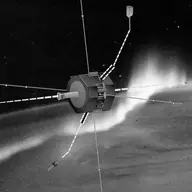
FAST
282 tracked publications and 9,574 citations from 1997–2026. Fast Auroral Snapshot Explorer. Launched 1996. Life-cycle cost: $117M in 2025 dollars. Active Mission Window September 1, 1996 to June 1, 2011: 212 publications, 14 top-10% credit.
In-Situ Probe · h-index 53 · 23 papers with 100+ citations · prime mission ended 1997
Lifetime
Key measures
| Active Mission Window · papers September 1, 1996 to June 1, 2011 | |
|---|---|
| Tracked publications | 212 |
| Citations | 1,706 |
| Mean citations per publication | 8.0 |
| Median citations per publication | 5 |
| Uncited publications | 29 (14%) |
| Top-10% credit | 14 |
| Top-1% credit | 2 |
| Lifetime indices · every tracked publication to date, in any scope | |
|---|---|
| h-index | 53 |
| g-index | 85 |
| m-index, as of October 4, 2026 | 1.8 |
| tori | 51 |
| riq | 238 |
Tracked publications
FAST satellite observations of large-amplitude solitary structures
512
-
276
FAST satellite observations of electric field structures in the auroral zone
265
Modulated electron-acoustic waves in auroral density cavities: FAST observations
260
Factors controlling ionospheric outflows as observed at intermediate altitudes
245
The Fast Auroral SnapshoT (FAST) Mission
234
-
180
FAST satellite wave observations in the AKR source region
178
Variations in the polar cap area during two substorm cycles
171
-
169
Properties of small-scale Alfvén waves and accelerated electrons from FAST
153
Nonlinear two-stream instabilities as an explanation for auroral bipolar wave structures
150
Auroral ion acceleration in dispersive Alfvén waves
135
Microstructure of the auroral acceleration region as observed by FAST
124
-
124
Driven Alfven waves and electron acceleration: A FAST case study
116
Energy deposition by Alfvén waves into the dayside auroral oval: Cluster and FAST observations
114
parallel electric fields in discrete arcs
112
HEUVAC: A new high resolution solar EUV proxy model
112
FAST observations of VLF waves in the auroral zone: Evidence of very low plasma densities
104
How we found these papers
We searched NASA’s Astrophysics Data System (ADS) for peer-reviewed articles naming FAST in the title, abstract or keywords; standard filters drop articles that are not peer-reviewed and magazine pieces. SciX is ADS’s current interface.
((=abs:"Fast Auroral Snapshot" OR =abs:"Fast Auroral Snapshots" OR (abs:FAST AND (abs:satellite OR abs:spacecraft OR abs:mission OR abs:probe) AND (abs:aurora OR abs:auroral)) OR (abs:FAST AND (abs:satellite OR abs:spacecraft) AND (abs:ionospher* OR abs:magnetospher* OR abs:photoelectron*))) AND NOT =abs:"Aperture Spherical" AND NOT =abs:"FAST events" AND NOT =abs:"FAST perturbations" AND NOT =abs:"Swarm FAST") AND property:refereed AND doctype:article AND pubdate:[1996-09 TO 2040-01] AND NOT bibstem:("A&R" OR "AIASJ" OR "AeAm" OR "AirSp" OR "AsNow" OR "AsUAI" OR "AvWST" OR "C&E" OR "C&T" OR "CAPJ" OR "E&S" OR "ENews" OR "IrAJ" OR "JCos" OR "JRASC" OR "LAstr" OR "MNSSA" OR "Met" OR "NewSc" OR "Orion" OR "PhT" OR "PhTea" OR "PhuZ" OR "PhyOJ" OR "PhyW" OR "PlR" OR "SciAm" OR "SpFl" OR "ZemVs")
Added after review
- Simultaneous observations of solar wind plasma entry from FAST and POLAR Joint FAST and Polar observations of solar-wind plasma entering the cusp.
- Velocity-shear-driven ion-cyclotron waves and associated transverse ion heating Laboratory wave-heating experiments compared with FAST and other spacecraft observations.
- Characteristics of a stable arc based on FAST and MIRACLE observations Stable auroral arc studied with FAST and ground-based MIRACLE data.
- Cold flowing O⁺ beams in the lobe/mantle at Geotail: Does FAST observe the source? Uses FAST and Geotail data to test the source of tailward oxygen beams.
- The cross-polar potential drop and its correlation to the solar wind Uses FAST cross-polar potentials to study response to the solar wind.
- Nonlinear Model for Coherent Electric Field Structures in the Magnetosphere Electron-hole model that explains electric structures observed by FAST and Polar.
- Excitation of Alfvén waves by modulated HF heating of the ionosphere, with application to FAST observations Theory of heater-driven Alfvén waves applied to FAST observations.
- Electron acceleration observed by the FAST satellite within the IAR during a 3 Hz modulated EISCAT heater experiment FAST observations of electron acceleration during a heating experiment.
- Nonlinear Localized Electrostatic Structures and Their Experimental Diagnostics in the Magnetosphere Plasma Model of electrostatic structures compared with FAST, Polar and Geotail observations.
- BGK electron solitary waves in 3D magnetized plasma Solitary-wave theory that explains features observed by FAST.
- A telescopic and microscopic view of a magnetospheric substorm on 31 March 2001 Multi-spacecraft substorm study that includes FAST field and plasma data.
- Investigation into the spatial and temporal coherence of ionospheric outflow on January 9-12, 1997 Multi-satellite study of ionospheric outflow that includes FAST ion data.
- Lobe cell convection and field-aligned currents poleward of the region 1 current system Uses FAST field and particle data to study lobe-cell convection.
- Testing global storm-time electric field models using particle spectra on multiple spacecraft Uses FAST, Polar and Equator-S ion spectra to test storm-time electric field models.
- Cusp structures: combining multi-spacecraft observations with ground-based observations Cusp structure study building on joint FAST, Polar and Interball observations.
- Quantitative modelling of the closure of meso-scale parallel currents in the nightside ionosphere Current-closure modelling using FAST and Ørsted currents with radar data.
- Two-dimensional particle simulation of electromagnetic field signature associated with electrostatic solitary waves Simulation of solitary-wave field signatures compared with FAST and Polar measurements.
- An investigation of the field-aligned currents associated with a large-scale ULF wave using data from CUTLASS and FAST Uses FAST particle and field data with radar to study ULF wave currents.
- Global cooling and densification of the plasma sheet during an extended period of purely northward IMF on October 22-24, 2003 Plasma sheet study using FAST cusp observations during northward IMF.
- Alfvén waves and Poynting flux observed simultaneously by Polar and FAST in the plasma sheet boundary layer Simultaneous FAST and Polar observations of Alfvén waves and Poynting flux.
- Spatial and Temporal Cusp Structures Observed by Multiple Spacecraft and Ground Based Observations Review of cusp structure combining FAST, Polar, Interball, Cluster and radar results.
- HEUVAC: A new high resolution solar EUV proxy model Solar EUV model validated with FAST photoelectron measurements.
- Theoretical model and experimental diagnostics of nonlinear electrostatic structures in space plasma Model of electrostatic structures compared with FAST, Polar and Geotail observations.
- Mapping of Poynting flux and widths of inertial Alfvén wave structures in high-latitude plasmas Alfvén-wave Poynting-flux scaling constrained by FAST-observed wave widths.
- Observation of two distinct, rapid loss mechanisms during the 20 November 2003 radiation belt dropout event Multi-satellite study of a radiation-belt dropout that includes FAST data.
- Temporal and spectral variations of the photoelectron flux and solar irradiance during an X class solar flare FAST photoelectron spectra during an X-class flare test solar irradiance models.
- Origin of ion-cyclotron turbulence in the downward Birkeland current region Instability analysis of electron distributions measured by FAST.
- Investigation of the broadband ELF turbulence by observations of the FAST satellite Uses FAST electric field data to study broadband ELF turbulence.
- Solar EUV and XUV energy input to thermosphere on solar rotation time scales derived from photoelectron observations FAST photoelectron spectra test solar irradiance models over solar rotations.
- Photoelectron flows in the polar wind during geomagnetically quiet periods Uses FAST data to study photoelectron flows in the polar wind.
- Seasonal asymmetry in the broadband ELF electric fields observed by the FAST satellite Uses FAST electric field data to find a seasonal asymmetry in ELF turbulence.
- Correlations between variations in solar EUV and soft X-ray irradiance and photoelectron energy spectra observed on Mars and Earth Compares FAST photoelectron spectra at Earth with Mars Global Surveyor data.
- Parametric study of density cavities caused by ion outflow in the topside ionosphere Ionospheric outflow model reproduces a density cavity observed by FAST.
- Compressive and Rarefactive Ion Acoustic Nonlinear Periodic Waves in Nonthermal Plasmas Nonlinear wave model that accounts for structures observed by FAST and Polar.
- The Relationship Between Cusp Region Ion Outflows and East-West Magnetic Field Fluctuations at 4,000-km Altitude Uses FAST cusp measurements to relate ion outflows to magnetic fluctuations.
- Violation of Hemispheric Symmetry in Integrated Poynting Flux via an Empirical Model Uses FAST-derived empirical models to test hemispheric Poynting-flux asymmetry.
- Validation of Simulated Statistical Characteristics of Magnetosphere-Ionosphere Coupling in Global Geospace Simulations Over an Entire Carrington Rotation Global simulation validated against FAST Alfvénic Poynting-flux observations.
- Deployment Mechanisms on the Fast Satellite: Magnetometer, Radial Wire, and Axial Booms Design, testing and on-orbit deployment of the FAST spacecraft booms.
- Science Operations and Data Handling for the FAST Satellite FAST science operations, data processing and analysis software.
Removed after review
- The EISCAT Svalbard radar: A case study in modern incoherent scatter radar system design Design of the EISCAT Svalbard radar; mentions FAST only as a supported satellite.
- Wave-Particle Correlator Instrument Design Design of wave-particle correlator instruments; reports no results.
- Geomagnetic Field Investigation on the POLAR Microsatellite SACI-I Plans for the Brazilian SACI-1 satellite; mentions FAST only as a future partner.
- Detecting exoplanets with FAST? FAST here is the Chinese radio telescope, not the NASA spacecraft.
- 2025A&A...695A..95Z FAST here is the Chinese radio telescope, not the NASA spacecraft.