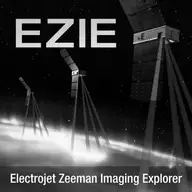
Electrojet Zeeman Imaging Explorer (EZIE)
Constellation · Competed · PI-led · Launched on March 15, 2025 · Extended Mission · LCC: $66M/$68M (2025 $) · Wikipedia
This mission is not yet included in the analysis because its publication and citation windows have not matured for comparison. Expected inclusion date: . Only lifetime data is shown. Maturity rules.
| Tracked publications | 2 |
|---|---|
| Citations | 2 |
| Citation indices | |
|---|---|
| h-index | 1 |
| g-index | 1 |
| m-index | 0.5 |
| tori | 0.0 |
| riq | 53 |
Publications and citations by year (lifetime)
Publications per yearCumulative citations
Tracked publications over the lifetime (2)
The SciX Query
We searched NASA’s Science Explorer (SciX) for peer-reviewed articles naming EZIE in the title, abstract or keywords; standard filters drop articles that are not peer-reviewed and magazine pieces.
((=abs:"Electrojet Zeeman Imaging Explorer" OR (abs:"EZIE" AND (abs:"electrojet" OR abs:"auroral" OR abs:"Zeeman" OR abs:magnet*)))) AND property:refereed AND doctype:article AND pubdate:[2025-06 TO 2040-01] AND NOT bibstem:("A&R" OR "ACPD" OR "AIASJ" OR "AMTD" OR "AeAm" OR "AirSp" OR "AsNow" OR "AsUAI" OR "AvWST" OR "BGD" OR "C&E" OR "C&T" OR "CAPJ" OR "CliPD" OR "E&S" OR "ENews" OR "ESDD" OR "ESSDD" OR "ESuDD" OR "GID" OR "GMDD" OR "GeCAS" OR "HESSD" OR "IrAJ" OR "JCos" OR "JRASC" OR "LAstr" OR "MNSSA" OR "Met" OR "NHESD" OR "NPGD" OR "NewSc" OR "OcScD" OR "Orion" OR "PhT" OR "PhTea" OR "PhuZ" OR "PhyOJ" OR "PhyW" OR "PlR" OR "SOILD" OR "SciAm" OR "SpFl" OR "TCD" OR "ZemVs")
Removed after review
- Impact of Terrestrial Weather on the Space Weather of the Ionosphere-Thermosphere: Initial Results from a NASA Living with a Star Focused Science Topic Review of ionospheric modeling that presents EZIE only as a future data source; analyzes no EZIE observations.