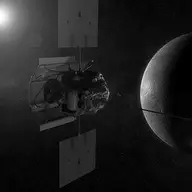
MESSENGER
761 tracked publications and 26,617 citations from 2008–2026. MErcury Surface, Space ENvironment, GEochemistry, and Ranging. Launched 2004. Life-cycle cost: $778M in 2025 dollars. Active Mission Window May 1, 2011 to May 1, 2017: 301 publications, 43 top-10% credit.
Orbiter · h-index 82 · 62 papers with 100+ citations · prime mission ended 2012
Lifetime
Key measures
| Active Mission Window · papers May 1, 2011 to May 1, 2017 | |
|---|---|
| Tracked publications | 301 |
| Citations | 4,938 |
| Mean citations per publication | 16 |
| Median citations per publication | 11 |
| Uncited publications | 10 (3.3%) |
| Top-10% credit | 43 |
| Top-1% credit | 2 |
| Lifetime indices · every tracked publication to date, in any scope | |
|---|---|
| h-index | 82 |
| g-index | 118 |
| m-index, as of October 4, 2026 | 4.3 |
| tori | 70 |
| riq | 440 |
Tracked publications
The Major-Element Composition of Mercury’s Surface from MESSENGER X-ray Spectrometry
431
The Global Magnetic Field of Mercury from MESSENGER Orbital Observations
281
Gravity Field and Internal Structure of Mercury from MESSENGER
267
Flood Volcanism in the Northern High Latitudes of Mercury Revealed by MESSENGER
246
MESSENGER Observations of Magnetic Reconnection in Mercury’s Magnetosphere
240
The curious case of Mercury's internal structure
240
Report of the IAU Working Group on Cartographic Coordinates and Rotational Elements: 2015
234
The distribution and origin of smooth plains on Mercury
232
The Evolution of Mercury’s Crust: A Global Perspective from MESSENGER
224
Mercury's magnetopause and bow shock from MESSENGER Magnetometer observations
215
-
211
Mercury's global contraction much greater than earlier estimates
183
Topography of the Northern Hemisphere of Mercury from MESSENGER Laser Altimetry
182
Volcanism on Mercury: Evidence from the First MESSENGER Flyby
180
Reflectance and Color Variations on Mercury: Regolith Processes and Compositional Heterogeneity
176
MESSENGER Observations of Extreme Loading and Unloading of Mercury’s Magnetic Tail
173
-
173
Evidence for Water Ice Near Mercury’s North Pole from MESSENGER Neutron Spectrometer Measurements
173
-
172
The Structure of Mercury’s Magnetic Field from MESSENGER’s First Flyby
165
How we found these papers
We searched NASA’s Astrophysics Data System (ADS) for peer-reviewed articles naming MESSENGER in the title, abstract or keywords; standard filters drop articles that are not peer-reviewed and magazine pieces. SciX is ADS’s current interface.
((((=abs:"Mercury Surface, Space Environment, Geochemistry, and Ranging" OR (abs:MESSENGER AND (abs:Mercury OR abs:hermean OR abs:mission OR abs:probe OR abs:spacecraft)) OR =abs:"Mercury Dual Imaging System" OR =abs:"MESSENGER X-Ray Spectrometer" OR =abs:"MESSENGER Gamma-Ray Spectrometer" OR =abs:"MESSENGER Neutron Spectrometer" OR =abs:"MESSENGER Magnetometer" OR =abs:"Mercury Laser Altimeter" OR =abs:"MESSENGER Energetic Particle and Plasma Spectrometer")) OR =abs:"Mercury Atmospheric and Surface Composition Spectrometer" OR ((abs:MASCS OR abs:MDIS OR abs:FIPS OR abs:EPPS OR =abs:"Fast Imaging Plasma Spectrometer") AND (abs:Mercury OR abs:hermean OR abs:MESSENGER)) OR facility:MESSENGER)) AND property:refereed AND doctype:article AND pubdate:[2011-05 TO 2040-01] AND NOT bibstem:("A&R" OR "AIASJ" OR "AeAm" OR "AirSp" OR "AsNow" OR "AsUAI" OR "AvWST" OR "C&E" OR "C&T" OR "CAPJ" OR "E&S" OR "ENews" OR "IrAJ" OR "JCos" OR "JRASC" OR "LAstr" OR "MNSSA" OR "Met" OR "NewSc" OR "Orion" OR "PhT" OR "PhTea" OR "PhuZ" OR "PhyOJ" OR "PhyW" OR "PlR" OR "SciAm" OR "SpFl" OR "ZemVs")
Added after review
- MESSENGER Observations of Magnetic Reconnection in Mercury’s Magnetosphere Uses magnetometer data from MESSENGER's second Mercury flyby.
- The Evolution of Mercury’s Crust: A Global Perspective from MESSENGER Uses MDIS camera data from MESSENGER's second Mercury flyby.
- Volcanism on Mercury: Evidence from the First MESSENGER Flyby Uses MDIS camera data from MESSENGER's first Mercury flyby.
- Reflectance and Color Variations on Mercury: Regolith Processes and Compositional Heterogeneity Uses MDIS camera data from MESSENGER's first Mercury flyby.
- MESSENGER Observations of Extreme Loading and Unloading of Mercury’s Magnetic Tail Uses magnetometer data from MESSENGER's third Mercury flyby.
- Mercury's Magnetosphere After MESSENGER's First Flyby Uses magnetometer data from MESSENGER's first Mercury flyby.
- The Structure of Mercury’s Magnetic Field from MESSENGER’s First Flyby Uses magnetometer data from MESSENGER's first Mercury flyby.
- Geology of the Caloris Basin, Mercury: A View from MESSENGER Uses MDIS camera data from MESSENGER's first Mercury flyby.
- Return to Mercury: A Global Perspective on MESSENGER’s First Mercury Flyby Uses MDIS camera data from MESSENGER's first Mercury flyby.
- The optical effects of small iron particles that darken but do not redden: Evidence of intense space weathering on Mercury Uses MASCS spectrometer data from MESSENGER's Mercury flybys.
- Anomalous Orbital-Energy Changes Observed during Spacecraft Flybys of Earth Uses Doppler tracking of MESSENGER's Earth flyby, among other spacecraft flybys.
- The tectonics of Mercury: The view after MESSENGER's first flyby Uses MDIS camera data from MESSENGER's first Mercury flyby.
- Explosive volcanic eruptions on Mercury: Eruption conditions, magma volatile content, and implications for interior volatile abundances Uses MDIS camera data from MESSENGER's first Mercury flyby.
- Mercury Cratering Record Viewed from MESSENGER’s First Flyby Uses MDIS camera data from MESSENGER's first Mercury flyby.
- MESSENGER Observations of the Composition of Mercury’s Ionized Exosphere and Plasma Environment Uses plasma spectrometer data from MESSENGER's first Mercury flyby.
- Spectroscopic Observations of Mercury’s Surface Reflectance During MESSENGER’s First Mercury Flyby Uses MASCS spectrometer data from MESSENGER's first Mercury flyby.
- Volcanism on Mercury: Evidence from the first MESSENGER flyby for extrusive and explosive activity and the volcanic origin of plains Uses MDIS camera data from MESSENGER's first Mercury flyby.
- Mercury’s magnetospheric magnetic field after the first two MESSENGER flybys Uses magnetometer data from MESSENGER's first two Mercury flybys.
- Evidence for Young Volcanism on Mercury from the Third MESSENGER Flyby Uses MDIS camera data from MESSENGER's third Mercury flyby.
- Caloris impact basin: Exterior geomorphology, stratigraphy, morphometry, radial sculpture, and smooth plains deposits Uses MDIS camera data from MESSENGER's first Mercury flyby.
- Observations of ion cyclotron waves in the solar wind near 0.3 AU Uses magnetometer data from MESSENGER's cruise to Mercury.
- Multispectral images of Mercury from the first MESSENGER flyby: Analysis of global and regional color trends Uses MDIS camera data from MESSENGER's first Mercury flyby.
- The Magnetic Field of Mercury Uses magnetometer data from MESSENGER's first two Mercury flybys.
- MESSENGER Observations of Mercury’s Exosphere: Detection of Magnesium and Distribution of Constituents Uses MASCS spectrometer data from MESSENGER's second Mercury flyby.
- Mercury’s Exosphere: Observations During MESSENGER’s First Mercury Flyby Uses MASCS spectrometer data from MESSENGER's first Mercury flyby.
- Exposure of spectrally distinct material by impact craters on Mercury: Implications for global stratigraphy Uses MDIS camera data from MESSENGER's first two Mercury flybys.
- Mercury’s magnetosphere-solar wind interaction for northward and southward interplanetary magnetic field: Hybrid simulation results Uses magnetometer data from MESSENGER's first two Mercury flybys.
- A solar storm observed from the Sun to Venus using the STEREO, Venus Express, and MESSENGER spacecraft Uses magnetometer data from MESSENGER's cruise to Mercury.
- Mercury’s Complex Exosphere: Results from MESSENGER’s Third Flyby Uses MASCS spectrometer data from MESSENGER's third Mercury flyby.
- Modeling of the magnetosphere of Mercury at the time of the first MESSENGER flyby Uses magnetometer data from MESSENGER's first Mercury flyby.
- MESSENGER observations of large flux transfer events at Mercury Uses magnetometer data from MESSENGER's first two Mercury flybys.
- Emplacement and tectonic deformation of smooth plains in the Caloris basin, Mercury Uses MDIS camera data from MESSENGER's first Mercury flyby.
- Nature of opaque components on Mercury: Insights into a Mercurian magma ocean Uses MDIS camera data from MESSENGER's 2008 Mercury flybys.
- Pit-floor craters on Mercury: Evidence of near-surface igneous activity Uses MDIS camera data from MESSENGER's first Mercury flyby.
- Identification and measurement of neutron-absorbing elements on Mercury’s surface Uses neutron spectrometer data from MESSENGER's Mercury flybys.
- The morphology of Mercury’s Caloris basin as seen in MESSENGER stereo topographic models Uses MDIS camera data from MESSENGER's 2008 Mercury flybys.
- Observations of Kelvin-Helmholtz waves along the dusk-side boundary of Mercury's magnetosphere during MESSENGER's third flyby Uses magnetometer data from MESSENGER's third Mercury flyby.
- Evolution of the Rembrandt Impact Basin on Mercury Uses MDIS camera data from MESSENGER's second Mercury flyby.
- MESSENGER observations of Mercury's magnetosphere during northward IMF Uses magnetometer data from MESSENGER's first Mercury flyby.
- Monte Carlo modeling of sodium in Mercury’s exosphere during the first two MESSENGER flybys Uses MASCS spectrometer data from MESSENGER's first two Mercury flybys.
- Evidence for intrusive activity on Mercury from the first MESSENGER flyby Uses MDIS camera data from MESSENGER's first Mercury flyby.
- MESSENGER and Venus Express observations of the solar wind interaction with Venus Uses magnetometer data from MESSENGER's Venus flyby.
- Modeling Mercury's internal magnetic field with smooth inversions Uses magnetometer data from MESSENGER's first Mercury flyby.
- Whole-disk spectrophotometric properties of Mercury: Synthesis of MESSENGER and ground-based observations Uses MDIS camera data from MESSENGER's Mercury flybys.
- The equatorial shape and gravity field of Mercury from MESSENGER flybys 1 and 2 Uses laser altimeter data from MESSENGER's first two Mercury flybys.
- Laser Altimeter Observations from MESSENGER’s First Mercury Flyby Uses laser altimeter data from MESSENGER's first Mercury flyby.
- The Kelvin-Helmholtz instability at Mercury: An assessment Uses magnetometer data from MESSENGER's first Mercury flyby.
- Constraints on Mercury’s Na exosphere: Combined MESSENGER and ground-based data Uses MASCS spectrometer data from MESSENGER's first Mercury flyby.
- The apparent lack of lunar-like swirls on Mercury: Implications for the formation of lunar swirls and for the agent of space weathering Uses MDIS camera data from MESSENGER's Mercury flybys.
- Accommodation of lithospheric shortening on Mercury from altimetric profiles of ridges and lobate scarps measured during MESSENGER flybys 1 and 2 Uses laser altimeter data from MESSENGER's first two Mercury flybys.
Removed after review
- Innovations in plasma sensors Review of plasma sensor design using MESSENGER's FIPS as a hardware case study.
- High-speed scientific spacecraft launches with commercial launch vehicles Launch vehicle study for future fast missions; names MESSENGER only as a past example.
- Planetary science: Mercury's mysteries start to unfold News & Views commentary on other papers; not a research paper.
- Icarus: In-situ monitoring of the surface degradation on a near-Sun asteroid Concept for a proposed near-Sun asteroid mission; names MESSENGER as design heritage.
- Detecting negative ions on board small satellites Proposes a CubeSat instrument adapted from MESSENGER's FIPS; reports no results.
- BepiColombo set to probe Mercury's mysteries News article; not a research paper.
- 2018PNAS..115.8907L Merely mentions ice on Mercury and does not acknowledge MESSENGER results.
- Thermal Effects on Camera Focal Length in Messenger Star Calibration and Orbital Imaging Duplicate record of 2018ISPAr42.3..103B (same paper).
- High-Resolution Topography of Mercury from Messenger Orbital Stereo Imaging ─ the Southern Hemisphere Quadrangles Duplicate record of 2018ISPAr42.3.1389P (same paper).
- 2007SSRv..131....1D Foreword to a journal special issue; not a research paper.
- 2007SSRv..131...41H Review of Mercury geology before MESSENGER; names the mission only as future work.
- 2007SSRv..131..161D Review of Mercury's exosphere from earlier data; uses no MESSENGER data.
- 2007SSRv..131..105Z Review of Mercury geophysics before MESSENGER; anticipates its results but uses no data.