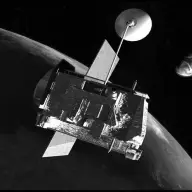
Lunar Reconnaissance Orbiter (LRO)
Orbiter · Directed · Agency-led · Launched on June 18, 2009 · Extended Mission · LCC: $602M/$941M (2025 $) · Wikipedia · Mission-curated bibliography
| Tracked publications | 767 |
|---|---|
| Citations | 8,111 |
| Top-10% papers | 44 |
| Top-1% papers | 2 |
| Citation indices | |
|---|---|
| h-index | 35 |
| g-index | 48 |
| m-index | 2.5 |
| tori | 162 |
| riq | 708 |
Publications and citations by year (lifetime)
Publications per yearCumulative citations
Institutional contributions
Tracked publications over the lifetime (1,018)
Lunar Reconnaissance Orbiter Camera (LROC) Instrument Overview
1,072
The Lunar Orbiter Laser Altimeter Investigation on the Lunar Reconnaissance Orbiter Mission
490
A new lunar digital elevation model from the Lunar Orbiter Laser Altimeter and SELENE Terrain Camera
490
Diviner Lunar Radiometer Observations of Cold Traps in the Moon’s South Polar Region
478
Initial observations from the Lunar Orbiter Laser Altimeter (LOLA)
453
Direct evidence of surface exposed water ice in the lunar polar regions
438
The Lunar Reconnaissance Orbiter Diviner Lunar Radiometer Experiment
427
The global surface temperatures of the Moon as measured by the Diviner Lunar Radiometer Experiment
385
Global Regolith Thermophysical Properties of the Moon From the Diviner Lunar Radiometer Experiment
339
Illumination conditions of the lunar polar regions using LOLA topography
328
Hydrogen Mapping of the Lunar South Pole Using the LRO Neutron Detector Experiment LEND
313
-
299
-
269
Optical measurements of the Moon as a tool to study its surface
262
-
227
Global Silicate Mineralogy of the Moon from the Diviner Lunar Radiometer
221
Lunar mare TiO₂ abundances estimated from UV/Vis reflectance
220
Highly Silicic Compositions on the Moon
211
GLD100: The near-global lunar 100 m raster DTM from LROC WAC stereo image data
188
Evidence for basaltic volcanism on the Moon within the past 100 million years
180
The SciX Query
We searched NASA’s Science Explorer (SciX) for peer-reviewed articles naming LRO in the title, abstract, or keywords; standard filters drop articles that are not peer-reviewed and magazine pieces.
((=abs:"Lunar Reconnaissance Orbiter" OR =abs:"Lunar Reconnaissance Orbiter Camera" OR =abs:"Lunar Exploration Neutron Detector" OR =abs:"Lyman-Alpha Mapping Project" OR =abs:"Lunar Orbiter Laser Altimeter" OR =abs:"Cosmic Ray Telescope for the Effects of Radiation" OR =abs:"Diviner Lunar Radiometer" OR ((=abs:Moon OR =abs:lunar) AND (abs:LRO OR =abs:LROC OR abs:LEND OR abs:LAMP OR abs:LOLA OR abs:CRaTER OR =abs:Diviner OR abs:"Mini-RF")))) AND property:refereed AND doctype:article AND pubdate:[2009-10 TO 2040-01] AND NOT bibstem:("A&R" OR "ACPD" OR "AIASJ" OR "AMTD" OR "AeAm" OR "AirSp" OR "AsNow" OR "AsUAI" OR "AvWST" OR "BGD" OR "C&E" OR "C&T" OR "CAPJ" OR "CliPD" OR "E&S" OR "ENews" OR "ESDD" OR "ESSDD" OR "ESuDD" OR "GID" OR "GMDD" OR "GeCAS" OR "HESSD" OR "IrAJ" OR "JCos" OR "JRASC" OR "LAstr" OR "MNSSA" OR "Met" OR "NHESD" OR "NPGD" OR "NewSc" OR "OcScD" OR "Orion" OR "PhT" OR "PhTea" OR "PhuZ" OR "PhyOJ" OR "PhyW" OR "PlR" OR "SOILD" OR "SciAm" OR "SpFl" OR "TCD" OR "ZemVs")
Removed after review
- The Ultraviolet Spectrograph on NASA's Juno Mission Describes Juno's ultraviolet spectrograph; mentions LRO only as design heritage.
- The ARTEMIS Mission Overview of the ARTEMIS mission; mentions LRO only as a concurrent mission.
- Dose spectra from energetic particles and neutrons Describes a proposed dosimeter; mentions CRaTER only as a design analogue.
- Promising Neutron Detector with Anticoincidence Protection Describes a proposed neutron detector design; reports no LRO results.
- Preface: The Lunar Reconnaissance Orbiter Editorial preface to a journal special issue; not a research paper.
- Introduction to special section on Results of the Lunar Reconnaissance Orbiter Mission Editorial introduction to a journal special section; not a research paper.
- The Lunar Crater Observation and Sensing Satellite (LCROSS) Payload Development and Performance in Flight Describes the LCROSS instrument payload; mentions LRO only as a co-launched mission.
- ShadowCam Instrument and Investigation Overview Instrument overview of ShadowCam (KPLO); mentions LROC only as a comparison.
- Chandrayaan-2 dual-frequency SAR: Further investigation into lunar water and regolith Pre-launch description of the Chandrayaan-2 radar; mentions Mini-RF only as context.
- The First Laser Retroreflector on the Lunar Far Side Onboard China's Chang'e-6 Lander Describes the Chang'e-6 laser retroreflector; mentions LOLA only as a possible future observer.
- Characterization of Regolith And Trace Economic Resources (CRATER): An Orbitrap-based laser desorption mass spectrometry instrument for in situ exploration of the Moon Describes an unrelated instrument named CRATER; not LRO's CRaTER.
- An Overview of the Lunar Crater Observation and Sensing Satellite (LCROSS) Overview of the LCROSS mission; mentions LRO only as its launch companion.
- A compact, low-power epithermal neutron counter for lunar water detection Describes a neutron detector for future lunar rovers; names LRO only as earlier work.
- SMART-1 technology, scientific results and heritage for future space missions Retrospective of ESA's SMART-1 lunar mission; names LRO only among later missions it helped prepare.