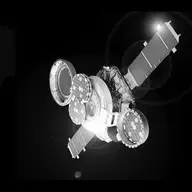
Genesis
72 tracked publications and 3,826 citations from 2003–2026. Launched 2001. Life-cycle cost: $411M in 2025 dollars. Active Mission Window December 1, 2001 to October 1, 2006: 10 publications, 1 top-10% credit.
Sample Return · h-index 29 · 7 papers with 100+ citations · prime mission ended 2003
Lifetime
Key measures
| Active Mission Window · papers December 1, 2001 to October 1, 2006 | |
|---|---|
| Tracked publications | 10 |
| Citations | 108 |
| Mean citations per publication | 11 |
| Median citations per publication | 8 |
| Uncited publications | 0 (0%) |
| Top-10% credit | 1 |
| Top-1% credit | 0 |
| Lifetime indices · every tracked publication to date, in any scope | |
|---|---|
| h-index | 29 |
| g-index | 61 |
| m-index, as of October 4, 2026 | 1.2 |
| tori | 21 |
| riq | 189 |
Tracked publications
The chemical make-up of the Sun: A 2020 vision
821
The Oxygen Isotopic Composition of the Sun Inferred from Captured Solar Wind
321
A ¹⁵N-Poor Isotopic Composition for the Solar System As Shown by Genesis Solar Wind Samples
247
Noble gas composition of the solar wind as collected by the Genesis mission
194
Nitrogen isotope variations in the Solar System
168
The Genesis Discovery Mission: Return of Solar Matter to Earth
157
Solar Wind Neon from Genesis: Implications for the Lunar Noble Gas Record
117
Heavy noble gases in solar wind delivered by Genesis mission
98
-
88
-
86
Refractory inclusions in carbonaceous chondrites: Records of early solar system processes
86
-
84
The Apollo SWC Experiment: Results, Conclusions, Consequences
83
The Genesis Solar-Wind Collector Materials
75
Genesis on-board determination of the solar wind flow regime
69
A light carbon isotope composition for the Sun
68
Elemental Abundances of the Bulk Solar Wind: Analyses from Genesis and ACE
61
Atmospheric ³⁸Ar/ ³⁶Ar in the mantle: Implications for the nature of the terrestrial parent bodies
58
-
54
Constraints on Neon and Argon Isotopic Fractionation in Solar Wind
53
How we found these papers
We searched NASA’s Astrophysics Data System (ADS) for peer-reviewed articles naming Genesis in the title, abstract or keywords; standard filters drop articles that are not peer-reviewed and magazine pieces. SciX is ADS’s current interface.
(((=abs:"Genesis mission" OR =abs:"Genesis space mission" OR =abs:"Genesis spacecraft" OR =abs:"Genesis sample return" OR =abs:"Genesis Discovery mission" OR =abs:"Genesis solar wind" OR =abs:"Genesis solar-wind" OR =abs:"Genesis probe" OR =abs:"Genesis collector" OR =abs:"Genesis collectors" OR =abs:"Genesis concentrator" OR =abs:"Genesis target" OR =abs:"Genesis targets" OR =abs:"Genesis samples" OR =abs:"Genesis capsule" OR =abs:"Genesis array" OR =abs:"Genesis regime") AND (abs:"solar" OR =abs:"Ion Monitor" OR =abs:"Electron Monitor" OR =abs:"space weather"))) AND property:refereed AND doctype:article AND pubdate:[2001-12 TO 2040-01] AND NOT bibstem:("A&R" OR "AIASJ" OR "AeAm" OR "AirSp" OR "AsNow" OR "AsUAI" OR "AvWST" OR "C&E" OR "C&T" OR "CAPJ" OR "E&S" OR "ENews" OR "IrAJ" OR "JCos" OR "JRASC" OR "LAstr" OR "MNSSA" OR "Met" OR "NewSc" OR "Orion" OR "PhT" OR "PhTea" OR "PhuZ" OR "PhyOJ" OR "PhyW" OR "PlR" OR "SciAm" OR "SpFl" OR "ZemVs")
Removed after review
- Far-out surface science: radiation-induced surface processes in the solar system Engineering/technique review of radiation-induced surface processes; Genesis is named only in a closing list of future missions, before any sample returned. Not a Genesis science result.
- A new time-of-flight instrument for quantitative surface analysis Engineering paper describing the Argonne time-of-flight mass spectrometer; Genesis samples are named only as an intended application.
- Experimental Test of Self-Shielding in Vacuum Ultraviolet Photodissociation of CO Engineering/laboratory paper on CO photodissociation at a synchrotron; Genesis is named only as a possible application in the final sentence.
- 2006PhDT.......207P Engineering thesis on multi-body transfer trajectory design; Genesis is cited only as a motivating example.
- 2005SpWea...311003L Editorial on the National Space Weather Program assessment; incidental mention, not a science paper.
- Oral Histories in Meteoritics and Planetary Science—XXI: Donald Burnett Oral-history interview with Donald Burnett; incidental mention, not a science paper.
- MegaSIMS: a SIMS/AMS hybrid for measurement of the Sun's oxygen isotopic composition Engineering/instrument paper describing the UCLA MegaSIMS instrument before Genesis samples were analyzed; no measurement.
- White light interferometry for quantitative surface characterization in ion sputtering experiments Engineering/technique paper on white-light interferometry; a Genesis Si collector is only a demonstration surface, no solar-wind result.
- The Genesis Solar Wind Concentrator: Flight and Post-Flight Conditions and Modeling of Instrumental Fractionation Instrument performance and modeling paper on the Genesis Concentrator flight and post-flight fractionation; not a solar-wind composition result.
- Steps toward accurate large-area analyses of Genesis solar wind samples: evaluation of surface cleaning methods using total reflection X-ray fluorescence spectrometry Sample-preparation method paper evaluating surface cleaning of Genesis samples by TXRF; no solar-wind result.
- Multiscale Magnetic Reconnection in the Genesis of Young Slow Solar Wind False positive. Parker Solar Probe study of slow solar wind origin; "genesis" is the common noun.
- Laser Ablation (193 nm), Purification and Determination of Very Low Concentrations of Solar Wind Nitrogen Implanted in Targets from the GENESIS Spacecraft Engineering/method paper describing the CRPG laser-ablation extraction and purification line for Genesis nitrogen; reports blanks, not a solar-wind result.