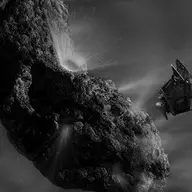
Deep Impact (EPOXI)
314 tracked publications and 12,039 citations from 2005–2026. Deep Impact (EPOXI - Extrasolar Planet Observation and Deep Impact Extended Investigation). Launched 2005. Life-cycle cost: $624M in 2025 dollars. Active Mission Window July 1, 2005 to October 1, 2015: 276 publications, 30 top-10% credit.
Impactor · h-index 56 · 27 papers with 100+ citations · prime mission ended 2005
Lifetime
Key measures
| Active Mission Window · papers July 1, 2005 to October 1, 2015 | |
|---|---|
| Tracked publications | 276 |
| Citations | 3,939 |
| Mean citations per publication | 14 |
| Median citations per publication | 6 |
| Uncited publications | 16 (5.8%) |
| Top-10% credit | 30 |
| Top-1% credit | 4.0 |
| Lifetime indices · every tracked publication to date, in any scope | |
|---|---|
| h-index | 56 |
| g-index | 98 |
| m-index, as of October 4, 2026 | 2.5 |
| tori | 53 |
| riq | 331 |
Tracked publications
Deep Impact: Excavating Comet Tempel 1
712
-
529
Temporal and Spatial Variability of Lunar Hydration As Observed by the Deep Impact Spacecraft
440
-
435
Spitzer Spectral Observations of the Deep Impact Ejecta
292
Exposed Water Ice Deposits on the Surface of Comet 9P/Tempel 1
234
A crater and its ejecta: An interpretation of Deep Impact
217
-
199
-
193
Alien Maps of an Ocean-bearing World
185
The primordial nucleus of comet 67P/Churyumov-Gerasimenko
170
Deep Impact: Observations from a Worldwide Earth-Based Campaign
167
Earth as an Extrasolar Planet: Earth Model Validation Using EPOXI Earth Observations
164
Parent Volatiles in Comet 9P/Tempel 1: Before and After Impact
146
A large dust/ice ratio in the nucleus of comet 9P/Tempel 1
132
Shape, density, and geology of the nucleus of Comet 103P/Hartley 2
124
A distribution of large particles in the coma of Comet 103P/Hartley 2
124
The shape, topography, and geology of Tempel 1 from Deep Impact observations
123
Surface temperature of the nucleus of Comet 9P/Tempel 1
121
Lunar soil hydration constrained by exospheric water liberated by meteoroid impacts
115
How we found these papers
We searched NASA’s Astrophysics Data System (ADS) for peer-reviewed articles naming Deep Impact (EPOXI) in the title, abstract or keywords; standard filters drop articles that are not peer-reviewed and magazine pieces. SciX is ADS’s current interface.
(((=abs:"Deep Impact" AND (=abs:"Tempel 1" OR abs:Tempel OR abs:Hartley OR abs:EPOXI OR abs:EPOCh OR abs:lunar OR abs:Moon OR =abs:"Deep Impact spacecraft" OR =abs:"Deep Impact mission" OR =abs:"Deep Impact flyby" OR =abs:"Deep Impact experiment" OR =abs:"Deep Impact encounter")) OR (abs:EPOXI AND (abs:comet OR abs:Hartley OR abs:exoplanet OR abs:transit OR abs:Earth OR abs:lunar OR abs:Moon OR abs:planet)) OR (abs:DIXI AND abs:Hartley))) AND property:refereed AND doctype:article AND pubdate:[2005-07 TO 2040-01] AND NOT bibstem:("A&R" OR "AIASJ" OR "AeAm" OR "AirSp" OR "AsNow" OR "AsUAI" OR "AvWST" OR "C&E" OR "C&T" OR "CAPJ" OR "E&S" OR "ENews" OR "IrAJ" OR "JCos" OR "JRASC" OR "LAstr" OR "MNSSA" OR "Met" OR "NewSc" OR "Orion" OR "PhT" OR "PhTea" OR "PhuZ" OR "PhyOJ" OR "PhyW" OR "PlR" OR "SciAm" OR "SpFl" OR "ZemVs")
Added after review
- Parent Volatiles in Comet 9P/Tempel 1: Before and After Impact Ground-based measurements of the ejecta from the Deep Impact collision with comet Tempel 1.
- The impact and rotational light curves of Comet 9P/Tempel 1 Ground-based light curves of comet Tempel 1 during the Deep Impact collision.
- The nucleus of Comet 9P/Tempel 1: Shape and geology from two flybys Comet Tempel 1 nucleus geology from Deep Impact and Stardust-NExT imaging.
Removed after review
- Deep Impact: sifting through the debris incidental: Nature news article by a staff journalist (Peplow, "Deep Impact: sifting through the debris"); reports the mission, presents no result. News articles are excluded as a general rule (owner decision 2026-09-07).
- Hydrogen cyanide polymers, comets and the origin of life Mentions Deep Impact only as a possible future source of evidence; uses none of its data.
- Deep Impact at Comet Tempel 1: Part 2 Editorial preface to a journal special issue; not a research paper.
- Deep Impact on Hartley 2 Journal editorial summary of another paper; not a research paper.
- 2005Orion..63f..11S Amateur-astronomy magazine news report; not a research paper.
- Alice: The rosetta Ultraviolet Imaging Spectrograph Instrument description of the Rosetta Alice ultraviolet spectrograph; Deep Impact is mentioned only as an observing campaign.