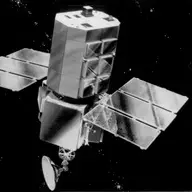
SMM
1,016 tracked publications and 39,661 citations from 1980–2026. Solar Maximum Mission. Launched 1980. Life-cycle cost: $581M in 2025 dollars. Active Mission Window March 1, 1980 to January 1, 1992: 678 publications, 61 top-10% credit.
Solar Observatory · h-index 91 · 79 papers with 100+ citations · prime mission ended 1982
Lifetime
Key measures
| Active Mission Window · papers March 1, 1980 to January 1, 1992 | |
|---|---|
| Tracked publications | 678 |
| Citations | 5,446 |
| Mean citations per publication | 8.0 |
| Median citations per publication | 5 |
| Uncited publications | 108 (16%) |
| Top-10% credit | 61 |
| Top-1% credit | 3 |
| Lifetime indices · every tracked publication to date, in any scope | |
|---|---|
| h-index | 91 |
| g-index | 154 |
| m-index, as of October 4, 2026 | 1.9 |
| tori | 541 |
| riq | 494 |
Tracked publications
NRLMSISE-00 empirical model of the atmosphere: Statistical comparisons and scientific issues
2,611
Sizes and locations of coronal mass ejections: SMM observations from 1980 and 1984-1989
492
Frequency distributions and correlations of solar X-ray flare parameters
491
Critical issues for understanding particle acceleration in impulsive solar flares
450
A 154-day periodicity in the occurrence of hard solar flares?
441
-
436
Revisiting the SN1987A gamma-ray limit on ultralight axion-like particles
389
Impulsive Phase of Flares in Soft X-Ray Emission
351
Observations of Solar Irradiance Variability
348
Observation of a coronal transient from 1.2 to 6 solar radii
332
The Neupert Effect: what can it tell up about the Impulsive and Gradual Phases of Solar Flares
303
Activity Associated with the Solar Origin of Coronal Mass Ejections
298
Disruption of a coronal streamer by an eruptive prominence and coronal mass ejection
289
Magnetic Modulation of Solar Luminosity by Photospheric Activity
283
The Sun's luminosity over a complete solar cycle
282
The initiation of coronal mass ejections by newly emerging magnetic flux
279
Injection Profiles of Solar Energetic Particles as Functions of Coronal Mass Ejection Heights
275
Gamma-ray line emission from SN1987A
266
Change of solar oscillation eigenfrequencies with the solar cycle
252
Solar luminosity variations in solar cycle 21
251
How we found these papers
We searched NASA’s Astrophysics Data System (ADS) for peer-reviewed articles naming SMM in the title, abstract or keywords; standard filters drop articles that are not peer-reviewed and magazine pieces. SciX is ADS’s current interface.
((=abs:"Solar Maximum Mission" OR facility:SMM OR (abs:SMM AND collection:astronomy NOT abs:(submillimeter OR submillimetre OR submm OR SCUBA OR protostar OR protostars OR protostellar OR Serpens OR lensed OR multifragmentation OR ULIRG) NOT =abs:"molecular gas" NOT =abs:"high redshift" NOT =abs:"high-redshift" NOT =abs:"mixture modeling") OR (=abs:"Solar Max" AND abs:(ACRIM OR blankets OR louver OR repair OR "space shuttle")) OR ((abs:HXIS OR =abs:"Hard X-ray Imaging Spectrometer") AND abs:(flare OR flares OR solar OR sun OR coronal OR arch OR arches) NOT abs:(STIX OR "Solar Orbiter" OR "ASO-S" OR Hitomi OR NuSTAR)) OR ((abs:HXRBS OR =abs:"Hard X-ray Burst Spectrometer") AND (abs:(flare OR flares OR solar OR sun OR "gamma-ray") OR =abs:"gamma rays") NOT abs:binaries) OR ((abs:UVSP OR =abs:"Ultraviolet Spectrometer and Polarimeter") AND abs:(solar OR sun OR flare OR flares OR ozone OR filament OR "transition region") NOT abs:Mars) OR ((abs:XRP OR =abs:"X-Ray Polychromator") AND abs:(flare OR flares OR "active region") NOT abs:pulsar) OR (=abs:"Coronagraph/Polarimeter" AND abs:(CME OR CMEs)) OR =abs:"ACRIM I" OR (abs:(ACRIM1 OR "ACRIM-1") AND abs:(irradiance OR TSI OR solar)))) AND property:refereed AND doctype:article AND pubdate:[1980-03 TO 2040-01] AND NOT bibstem:("A&R" OR "AIASJ" OR "AeAm" OR "AirSp" OR "AsNow" OR "AsUAI" OR "AvWST" OR "C&E" OR "C&T" OR "CAPJ" OR "E&S" OR "ENews" OR "IrAJ" OR "JCos" OR "JRASC" OR "LAstr" OR "MNSSA" OR "Met" OR "NewSc" OR "Orion" OR "PhT" OR "PhTea" OR "PhuZ" OR "PhyOJ" OR "PhyW" OR "PlR" OR "SciAm" OR "SpFl" OR "ZemVs")
Removed after review
- New Mauna Loa coronagraph systems Describes ground-based coronagraphs at Mauna Loa; reports no SMM results.
- A long duration balloon-borne telescope for solar gamma-ray astronomy Design of a balloon-borne gamma-ray telescope; cites SMM only for comparison.
- Plasma diagnostic capabilities of the Soft X-Ray Telescope on Solar-A Describes the Yohkoh soft X-ray telescope; SMM appears only through a mistaken keyword.
- The Hard X-ray Telescope (HXT) for the SOLAR-A mission Describes the Yohkoh hard X-ray telescope; reports no SMM results.
- FRESIP: A Mission to Determine the Character and Frequency of Extra-Solar Planets Around Solar-Like Stars Concept study for the FRESIP planet-finding mission; does not concern SMM.
- Melted micrometeorites from Antarctic ice with evidence for the separation of immiscible Fe-Ni-S liquids during entry heating. SMM here means a scoriaceous micrometeorite; unrelated to the Solar Maximum Mission.
- Impact of surface meteorological measurements on GPS height determination SMM here means surface meteorological measurements; unrelated to the Solar Maximum Mission.
- SMM, A New Seafloor Monitoring Module for Real-Time Data Transmission: an Application to Shallow Hydrothermal Vents SMM here is a seafloor monitoring module; unrelated to the Solar Maximum Mission.
- Frequency-domain terahertz transmission spectra of Mn₃ and Mn₁₂ single-molecule magnets SMM here means single-molecule magnets; unrelated to the Solar Maximum Mission.
- What did the seahorse swallow? APEX 170 GHz observations of the chemical conditions in the Seahorse infrared dark cloud SMM here labels submillimetre clumps in a dark cloud; unrelated to the Solar Maximum Mission.
- Cross sections for the production of radionuclides via ⁿᵃᵗCu(p,X) spallation reactions for proton energies from 250 MeV to 2 GeV SMM here is a nuclear reaction model; unrelated to the Solar Maximum Mission.
- 3D Joint Inversion of Scanning Magnetic Microscopy Data SMM here means scanning magnetic microscopy; unrelated to the Solar Maximum Mission.
- Instability analysis of Saturnian magnetospheric complex plasmas with heteropolar dust grains SMM here means Saturn's middle magnetosphere; unrelated to the Solar Maximum Mission.