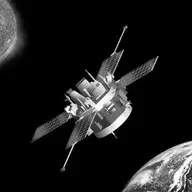
ACE
1,507 tracked publications and 53,419 citations from 1998–2026. Advanced Composition Explorer. Launched 1997. Life-cycle cost: $538M in 2025 dollars. Active Mission Window January 1, 1998 to January 1, 2024: 1,362 publications, 69 top-10% credit.
In-Situ Probe · h-index 105 · 118 papers with 100+ citations · prime mission ended 2002
Lifetime
Key measures
| Active Mission Window · papers January 1, 1998 to January 1, 2024 | |
|---|---|
| Tracked publications | 1,362 |
| Citations | 12,326 |
| Mean citations per publication | 9.1 |
| Median citations per publication | 6 |
| Uncited publications | 127 (9.3%) |
| Top-10% credit | 69 |
| Top-1% credit | 2.4 |
| Lifetime indices · every tracked publication to date, in any scope | |
|---|---|
| h-index | 105 |
| g-index | 167 |
| m-index, as of October 4, 2026 | 3.6 |
| tori | 309 |
| riq | 605 |
Tracked publications
Solar wind spatial scales in and comparisons of hourly Wind and ACE plasma and magnetic field data
1,197
Solar Wind Electron Proton Alpha Monitor (SWEPAM) for the Advanced Composition Explorer
1,054
The Advanced Composition Explorer
986
The ACE Magnetic Fields Experiment
972
Coronal Mass Ejections: Observations
706
Global dayside ionospheric uplift and enhancement associated with interplanetary electric fields
442
Predicting the 1-AU arrival times of coronal mass ejections
389
-
385
The association of coronal mass ejections with their effects near the Earth
359
Direct evidence for magnetic reconnection in the solar wind near 1 AU
359
-
358
Properties of Interplanetary Coronal Mass Ejections at One AU During 1995 2004
343
Electron, Proton, and Alpha Monitor on the Advanced Composition Explorer spacecraft
341
Flux tube texture of the solar wind: Strands of the magnetic carpet at 1 AU?
336
-
330
Properties of Stream Interactions at One AU During 1995 2004
302
Penetration of the solar wind electric field into the magnetosphere/ionosphere system
255
XMM-Newton Observation of Solar Wind Charge Exchange Emission
252
-
244
Energy partition in two solar flare/CME events
241
How we found these papers
We searched NASA’s Astrophysics Data System (ADS) for peer-reviewed articles naming ACE in the title, abstract or keywords; standard filters drop articles that are not peer-reviewed and magazine pieces. SciX is ADS’s current interface.
((((=abs:"Advanced Composition Explorer" OR =abs:"Solar Wind Ion Mass Spectrometer" OR =abs:"Solar Wind Ion Composition Spectrometer" OR =abs:"Ultra-Low Energy Isotope Spectrometer" OR =abs:"Solar Energetic Particle Ionic Charge Analyzer" OR =abs:"Solar Isotope Spectrometer" OR =abs:"Cosmic Ray Isotope Spectrometer" OR =abs:"Solar Wind Electron, Proton, and Alpha Monitor" OR =abs:"Electron, Proton, and Alpha-Particle Monitor" OR (abs:"ACE" AND (abs:"solar" OR abs:"cosmic") AND (abs:"SWICS" OR abs:"SWIMS" OR abs:"ULEIS" OR abs:"SEPICA" OR abs:"CRIS" OR abs:"SWEPAM" OR abs:"EPAM")))) OR (abs:ACE AND (=abs:"solar wind" OR =abs:"cosmic ray" OR abs:interplanetary OR abs:heliospher* OR abs:geomagnet* OR abs:magnetospher* OR abs:SWICS OR abs:SWIMS OR abs:ULEIS OR abs:SEPICA OR abs:CRIS OR abs:SWEPAM OR abs:EPAM)) OR ((abs:SWEPAM OR abs:ULEIS OR abs:SEPICA OR abs:EPAM) AND (abs:solar OR abs:interplanetary OR =abs:"energetic particle")))) AND property:refereed AND doctype:article AND pubdate:[1998-01 TO 2040-01] AND NOT bibstem:("A&R" OR "AIASJ" OR "AeAm" OR "AirSp" OR "AsNow" OR "AsUAI" OR "AvWST" OR "C&E" OR "C&T" OR "CAPJ" OR "E&S" OR "ENews" OR "IrAJ" OR "JCos" OR "JRASC" OR "LAstr" OR "MNSSA" OR "Met" OR "NewSc" OR "Orion" OR "PhT" OR "PhTea" OR "PhuZ" OR "PhyOJ" OR "PhyW" OR "PlR" OR "SciAm" OR "SpFl" OR "ZemVs")
Added after review
- Fast ejecta during the ascending phase of solar cycle 23: ACE observations, 1998-1999 Classifies fast solar wind ejecta using ACE observations from 1998-1999.
- Predicting the 1-AU arrival times of coronal mass ejections Constrains coronal mass ejection arrival times with SOHO, Wind and ACE data.
- Classification of solar energetic particles Classifies solar energetic particle populations using ACE heavy ion data.
- Prediction of the Dst index from solar wind parameters by a neural network method Predicts the Dst index from ACE solar wind data with a neural network.
- Near real-time predictions of the arrival at Earth of flare-related shocks during Solar Cycle 23 Tests shock arrival predictions against shocks measured by ACE.
- Observation of two distinct, rapid loss mechanisms during the 20 November 2003 radiation belt dropout event Uses ACE and radiation belt data to identify two electron loss mechanisms.
- Interaction of the bow shock with a tangential discontinuity and solar wind density decrease: Observations of predicted fast mode waves and magnetosheath merging Studies a bow shock interaction using ACE solar wind discontinuity observations.
- Predicting the arrival of high-speed solar wind streams at Earth using the STEREO Heliospheric Imagers Uses ACE observations of solar wind streams to test arrival predictions from STEREO.
- Stereoscopic Study of the Kinematic Evolution of a Coronal Mass Ejection and Its Driven Shock from the Sun to the Earth and the Prediction of Their Arrival Times Tracks a coronal mass ejection and its shock to Earth using ACE in situ data.
- Characterizing interplanetary shocks for development and optimization of an automated solar wind shock detection algorithm Characterises 209 interplanetary shocks in ACE plasma and magnetic field data.
- Real-Time Solar Wind Prediction Based on SDO/AIA Coronal Hole Data Relates coronal hole areas to solar wind speeds measured by ACE.
- Solar energetic electron events measured by MESSENGER and Solar Orbiter. Peak intensity and energy spectrum radial dependences: Statistical analysis Solar energetic electron radial dependence using ACE and inner-heliosphere spacecraft data.
- Solar Wind Data Assimilation in an Operational Context: Use of Near-Real-Time Data and the Forecast Value of an L5 Monitor Solar wind data assimilation using ACE and STEREO observations.
- Analytical Verification of the Normal Vector Determination Methods for Planar Magnetic Structures Identifies planar magnetic structures in ACE observations of CME sheaths.
- Optimization Algorithm for Determining the Source Surface Radius Based on Parker Solar Probe In Situ Measurements From Encounters 1 to 19 Optimises solar wind source-surface models, checked against ACE measurements.
- Operational models for forecasting Dst Dst forecast models driven by ACE solar wind data.
- Scaling and a Fokker-Planck model for fluctuations in geomagnetic indices and comparison with solar wind ε as seen by Wind and ACE Compares geomagnetic index fluctuations with solar wind driving seen by Wind and ACE.
- Tracking halo coronal mass ejections from 0-1 AU and space weather forecasting using the Solar Mass Ejection Imager (SMEI) Combines SMEI CME tracking with ACE shock arrival measurements.
- Proton temperature anisotropy in the magnetosheath: comparison of 3-D MHD modelling with Cluster data Magnetosheath modelling driven by ACE upstream solar wind measurements.
- Long-duration magnetic clouds: a comparison of analyses using torus- and cylinder-shaped flux rope models Fits magnetic clouds observed by Wind and ACE with flux rope models.
- A New Forecasting Index for Solar Wind Velocity Based on EIT 284 Å Observations Relates coronal hole brightness to solar wind speed measured by ACE.
- Enhancement of solar wind low-energy energetic particles as precursor of geomagnetic disturbance in operational geomagnetic forecast Relates ACE energetic particle enhancements to later geomagnetic disturbances.
- Simulation of the Unusual Solar Minimum with 3D SIP-CESE MHD Model by Comparison with Multi-Satellite Observations Solar minimum MHD simulation compared with ACE and other spacecraft data.
- Using spacecraft measurements ahead of Earth in the Parker spiral to improve terrestrial space weather forecasts Uses ACE and STEREO data to assess solar wind monitoring ahead of Earth.
- Composition Structure of Interplanetary Coronal Mass Ejections From Multispacecraft Observations, Modeling, and Comparison with Numerical Simulations Composition structure of interplanetary CMEs from ACE ion charge state data.
- Application of Spectrum of Energetic Protons Accelerated by CME to Geomagnetic Storm Forecast Relates ACE energetic proton spectra to geomagnetic storm forecasting.
- Pickup protons: Comparisons using the three-dimensional MHD HHMS-PI model and Ulysses SWICS measurements Pickup proton simulations constrained by ACE shock arrival times.
- A real-time forecast service for the ionospheric equatorial zonal electric field Forecasts equatorial electric fields from ACE interplanetary measurements.
- Ionospheric ion temperature forecasting in multiples of 27 days Links recurring ionospheric heating to solar wind streams observed by ACE.
- Solar wind driven empirical forecast models of the time derivative of the ground magnetic field Ground magnetic field forecast models driven by ACE solar wind data.
- Forecast of solar wind parameters according to STOP magnetograph observations Tests solar wind forecasts from magnetograph data against ACE wind speeds.
- A scheme for forecasting severe space weather Uses ACE solar wind events and modelling to identify drivers of severe storms.
- Forecast of the Quasi-Stationary and Transient Solar Wind Streams Based on Solar Observations in 2010 Tests solar wind stream forecasts against ACE velocities.
- Ion Charge States from a Global Time-dependent Wave-turbulence-driven Model of the Solar Wind: Comparison with in Situ Measurements Compares modelled solar wind charge states with ACE observations.
- Some characteristics of intense geomagnetic storms and their energy budget Energy budgets of intense geomagnetic storms from ACE solar wind data.
- Properties of AE indices derived from real-time global simulation and their implications for solar wind-magnetosphere coupling Global magnetosphere simulations driven by ACE solar wind data.
- Advance warning of high-speed ejecta based on real-time shock analyses: When fast-moving ejecta appear to be overtaking slow-moving shocks Analyses 39 shocks observed by ACE to anticipate fast ejecta.
- On the difference between real-time and research simulations with CTIPe Ionosphere-thermosphere simulations driven by ACE solar wind data.
- The ACE Science Center Describes the ACE Science Center that processes and distributes ACE data.
Removed after review
- The theoretical basis of ACE, an Age Calculation Engine for cosmogenic nuclides Describes software named ACE for cosmogenic nuclide dating; not the spacecraft.
- The helium isotopic ratio in the solar wind and ion fractionation in the corona by inefficient Coulomb drag Uses the SWICS instrument on Ulysses; does not name ACE.
- A model for pickup ion transport in the heliosphere in the limit of uniform hemispheric distributions Pickup ion model compared with Ulysses data; does not name ACE.
- Measurement of the Abundance of Helium-3 in the Sun and in the Local Interstellar Cloud with SWICS on ULYSSES Uses the SWICS instrument on Ulysses; does not name ACE.
- O⁵⁺ in High Speed Solar Wind Streams: SWICS/Ulysses Results Uses the SWICS instrument on Ulysses; does not name ACE.
- Advanced Composition Explorer mission. Proceedings. Workshop, Pasadena, CA (USA), Jan 1997. Record for a workshop proceedings volume; not a research paper.
- Interstellar and Inner Source Pickup Ions Observed with SWICS on ULYSSES Uses the SWICS instrument on Ulysses; does not name ACE.
- Identification of trailing edge solar wind stream interfaces: A comparison of Ulysses plasma and composition measurements Uses Ulysses plasma and composition data; does not name ACE.
- Solar wind stream interfaces in corotating interaction regions: New SWICS/Ulysses results Uses the SWICS instrument on Ulysses; does not name ACE.
- Solar wind ionic charge states during the Ulysses pole-to-pole pass Uses the SWICS instrument on Ulysses; does not name ACE.
- Implications of Solar Wind Composition for Cometary X-Rays Uses solar wind composition from Ulysses; does not name ACE.
- Elemental composition of the inner source pickup ions Uses the SWICS instrument on Ulysses; does not name ACE.
- Inner source distributions: Theoretical interpretation, implications, and evidence for inner source protons Uses the SWICS instrument on Ulysses; does not name ACE.
- Composition of quasi-stationary solar wind flows from Ulysses/Solar Wind Ion Composition Spectrometer Uses the SWICS instrument on Ulysses; does not name ACE.
- Stationkeeping Techniques for Libration-Point Satellites General stationkeeping study for libration-point satellites; does not name ACE.
- Ionization state and magnetic topology of coronal mass ejections Uses Ulysses instruments to study CMEs; does not name ACE.
- Nature of the boundary between open and closed magnetic field line regions at the Sun revealed by composition data and numerical models Uses Ulysses composition data; does not name ACE.
- The Sun at solar minimum: North - south asymmetry of the polar coronal holes Uses the SWICS instrument on Ulysses; does not name ACE.
- Temporal Evolution of a Streamer Complex: Coronal and in Situ Plasma Parameters Combines SOHO and Ulysses observations; does not name ACE.
- Interplanetary and solar surface properties of coronal holes observed during solar maximum Uses the SWICS instrument on Ulysses; does not name ACE.
- Implications of the observed anticorrelation between solar wind speed and coronal electron temperature Solar wind composition study that does not name ACE.
- Dust Destruction and Ion Formation in the Inner Solar System Interprets pickup ions measured by Ulysses; does not name ACE.
- Polar Coronal Holes During Solar Cycles 22 and 23 Uses the SWICS instrument on Ulysses; does not name ACE.
- Interstellar He⁺ ring-beam distributions: Observations and implications Uses STEREO pickup ion data; does not name ACE.
- Composition of inner-source heavy pickup ions at 1 AU: SOHO/CELIAS/CTOF observations. Implications for the production mechanisms Uses SOHO pickup ion data; does not name ACE.
- HEPPA-II model─measurement intercomparison project: EPP indirect effects during the dynamically perturbed NH winter 2008─2009 Uses the ACE-FTS instrument on SCISAT; not the Advanced Composition Explorer.
- Determination of Plasma, Pickup Ion, and Suprathermal Particle Spectrum in the Solar Wind Frame of Reference Uses the SWICS instrument on Ulysses; does not name ACE.
- Evaluating the Performance of a Plasma Analyzer for a Space Weather Monitor Mission Concept Design study of a plasma analyzer for a proposed space weather mission.
- Bulk Properties of Pickup Ions Derived from the Ulysses Solar Wind Ion Composition Spectrometer Data Uses the SWICS instrument on Ulysses; does not name ACE.
- Space Weather Science to Enhance Forecasting with the NASA IMAP Active Link for Real-Time (I-ALiRT) System Describes IMAP's real-time data system; mentions ACE only as design heritage.
- Do cosmic-ray-driven electron-induced reactions impact stratospheric ozone depletion and global climate change? Uses the ACE-FTS instrument on SCISAT; not the Advanced Composition Explorer.
- 2016JGRD..12110328A Uses the ACE-FTS instrument on SCISAT; not the Advanced Composition Explorer.
- Two- and three-dimensional structures of the descent of mesospheric trace constituents after the 2013 sudden stratospheric warming elevated stratopause event Refers to the ACE-FTS instrument on SCISAT; not the Advanced Composition Explorer.
- A Sanitizable and Bilateral Access Control Scheme Based on Blockchain ACE here means access control encryption; unrelated to the spacecraft.
- Proposed U.S. Space Weather Budget for Fiscal Year 2011 Would Fund Key Programs News item on the space weather budget; not a research paper.
- The Low-Energy Telescope (LET) and SEP Central Electronics for the STEREO Mission Instrument description of the STEREO Low-Energy Telescope; a different mission.
- The Plasma Ion and Electron Instruments for the Genesis Mission Instrument description of the Genesis plasma monitors; mentions ACE only as sensor heritage.
- Solar Wind and Pickup Ion (SWAPI) Instrument on NASA's Interstellar Mapping and Acceleration Probe (IMAP) Instrument description of the IMAP SWAPI instrument; a different mission.
- Martian Radiation EnvIronment Experiment (MARIE) Instrument description of MARIE on Mars Odyssey; mentions ACE only for comparison.
- The TRACERS Analyzer for Cusp Electrons Instrument description of a TRACERS electron analyzer; a different mission.