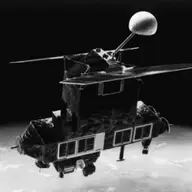
ERBS
843 tracked publications and 35,972 citations from 1984–2026. Earth Radiation Budget Satellite. Launched 1984. Life-cycle cost: $164M in 2025 dollars. Active Mission Window November 1, 1984 to November 1, 2007: 676 publications, 59 top-10% credit.
Orbiter · h-index 90 · 81 papers with 100+ citations · prime mission ended 1986
Lifetime
Key measures
| Active Mission Window · papers November 1, 1984 to November 1, 2007 | |
|---|---|
| Tracked publications | 676 |
| Citations | 5,296 |
| Mean citations per publication | 7.8 |
| Median citations per publication | 5 |
| Uncited publications | 102 (15%) |
| Top-10% credit | 59 |
| Top-1% credit | 2.3 |
| Lifetime indices · every tracked publication to date, in any scope | |
|---|---|
| h-index | 90 |
| g-index | 153 |
| m-index, as of October 4, 2026 | 2.1 |
| tori | 330 |
| riq | 422 |
Tracked publications
Cloud-Radiative Forcing and Climate: Results from the Earth Radiation Budget Experiment
1,281
The Seasonal Cycle of Low Stratiform Clouds.
1,235
-
834
Estimates of Meridional Atmosphere and Ocean Heat Transports.
594
The Effect of Cloud Type on Earth's Energy Balance: Global Analysis.
567
Seasonal variation of cloud radiative forcing derived from the Earth Radiation Budget Experiment
430
Distribution of tropospheric ozone determined from satellite data
357
The Earth Radiation Budget Experiment (ERBE).
342
SAGE II measurements of early Pinatubo aerosols
310
Observational determination of the greenhouse effect
306
A Prognostic Cloud Water Parameterization for Global Climate Models.
303
-
303
-
296
Radiative forcing from the 1991 Mount Pinatubo volcanic eruption
291
Large-Scale Ocean Heat and Freshwater Transports during the World Ocean Circulation Experiment.
286
-
274
-
270
The role of earth radiation budget studies in climate and general circulation research
258
Radiative Climate Forcing by the Mount Pinatubo Eruption
247
-
228
How we found these papers
We searched NASA’s Astrophysics Data System (ADS) for peer-reviewed articles naming ERBS in the title, abstract or keywords; standard filters drop articles that are not peer-reviewed and magazine pieces. SciX is ADS’s current interface.
((=abs:("Earth Radiation Budget Satellite" OR "Stratospheric Aerosol and Gas Experiment II") OR (=abs:"Earth Radiation Budget Experiment" NOT abs:Nimbus NOT =abs:("Geostationary Earth Radiation Budget" OR "Moon and Earth Radiation Budget")) OR (abs:ERBS AND abs:(stratospher* OR troposph* OR ozone OR aerosol OR aerosols OR cloud OR clouds OR cloudiness OR radiative OR irradiance OR albedo OR longwave OR shortwave OR occultation OR volcanic OR ="water vapor" OR NO2 OR ERBE OR SAGE OR OLR OR nonscanner OR scanner OR ="radiation budget")) OR (abs:ERBE AND abs:(atmosphere OR atmospheric OR stratospher* OR troposph* OR mesospher* OR ozone OR aerosol OR aerosols OR cloud OR clouds OR cloudiness OR radiation OR radiative OR irradiance OR climate OR albedo OR flux OR fluxes OR longwave OR shortwave OR limb OR occultation OR volcanic OR ="water vapor" OR NO2 OR satellite)) OR (=abs:("SAGE II" OR "SAGE I and II") AND abs:(atmosphere OR atmospheric OR stratospher* OR troposph* OR mesospher* OR ozone OR aerosol OR aerosols OR cloud OR clouds OR occultation OR extinction OR volcanic OR ="water vapor" OR NO2 OR limb OR climate)))) AND property:refereed AND doctype:article AND pubdate:[1984-11 TO 2040-01] AND NOT bibstem:("A&R" OR "AIASJ" OR "AeAm" OR "AirSp" OR "AsNow" OR "AsUAI" OR "AvWST" OR "C&E" OR "C&T" OR "CAPJ" OR "E&S" OR "ENews" OR "IrAJ" OR "JCos" OR "JRASC" OR "LAstr" OR "MNSSA" OR "Met" OR "NewSc" OR "Orion" OR "PhT" OR "PhTea" OR "PhuZ" OR "PhyOJ" OR "PhyW" OR "PlR" OR "SciAm" OR "SpFl" OR "ZemVs")
Removed after review
- Clouds and the Earth's Radiant Energy System (CERES): An Earth Observing System Experiment. Overview of the CERES investigation; mentions ERBE only as heritage and the record it extends.
- Clouds and the Earth's Radiant Energy System (CERES): algorithm overview Overview of CERES algorithms; mentions ERBE only as heritage and the record it extends.
- The CLoud─Aerosol─Radiation Interaction and Forcing: Year 2017 (CLARIFY-2017) measurement campaign Overview of an aircraft campaign; does not name ERBS or its instruments.
- Study of aerosol impact on the earth radiation budget with satellite data Aerosol study using AVHRR and ScaRaB data; does not concern ERBS.
- Aerosol impact on the earth radiation budget from satellite data - a study in support of the geostationary earth radiation budget experiment Aerosol study in support of the GERB instrument; does not concern ERBS.
- Evaluating the Design of an Earth Radiation Budget Instrument with System Simulations. Part II: Minimization of Instantaneous Sampling Errors for CERES-I Design simulations for the CERES instrument; does not concern ERBS.
- Angular sampling of a monochromatic, wide-field-of-view camera to augment next-generation Earth radiation budget satellite observations Concept study for the future Libera mission; does not concern ERBS.
- Optimizing Surface Type Definitions in Radiance-to-Irradiance Conversions for Future Earth Radiation Budget Satellite Measurements Method study for the future Libera mission; does not concern ERBS.
- Towards real-time PGS range monitoring in proton therapy of prostate cancer ERBs here are endorectal balloons in proton therapy; unrelated to the satellite.
- Low-energy Auger and conversion electron spectroscopy of ⁹⁹Mo β⁻-decay ERBS here is an electron backscattering technique; unrelated to the satellite.