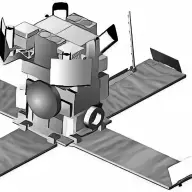
HETE 2
126 tracked publications and 10,983 citations from 2002–2024. High Energy Transient Explorer 2. Launched 2000. Life-cycle cost: $158M in 2025 dollars. Active Mission Window March 1, 2001 to April 1, 2010: 110 publications, 15 top-10% credit.
Survey Observatory · h-index 45 · 23 papers with 100+ citations · prime mission ended 2002
Lifetime
Key measures
| Active Mission Window · papers March 1, 2001 to April 1, 2010 | |
|---|---|
| Tracked publications | 110 |
| Citations | 3,600 |
| Mean citations per publication | 33 |
| Median citations per publication | 14 |
| Uncited publications | 14 (13%) |
| Top-10% credit | 15 |
| Top-1% credit | 4 |
| Lifetime indices · every tracked publication to date, in any scope | |
|---|---|
| h-index | 45 |
| g-index | 104 |
| m-index, as of October 4, 2026 | 1.8 |
| tori | 71 |
| riq | 366 |
Tracked publications
The physics of gamma-ray bursts
1,800
A very energetic supernova associated with the γ-ray burst of 29 March 2003
1,382
Spectroscopic Discovery of the Supernova 2003dh Associated with GRB 030329
1,183
The afterglow of GRB 050709 and the nature of the short-hard γ-ray bursts
495
Short Gamma-Ray Bursts with Extended Emission
476
A Study of Compact Object Mergers as Short Gamma-Ray Burst Progenitors
299
The optical afterglow of the short γ-ray burst GRB 050709
282
-
279
Global Characteristics of X-Ray Flashes and X-Ray-Rich Gamma-Ray Bursts Observed by HETE-2
242
The Second Swift Burst Alert Telescope Gamma-Ray Burst Catalog
236
Discovery of the short γ-ray burst GRB 050709
233
-
151
Spectral analysis of 35 GRBs/XRFs observed with HETE-2/FREGATE
144
A Redshift Determination for XRF 020903: First Spectroscopic Observations of an X-Ray Flash
136
The redshift distribution of Swift gamma-ray bursts: evidence for evolution
135
The BATSE-Swift luminosity and redshift distributions of short-duration GRBs
134
The First Swift Ultraviolet/Optical Telescope GRB Afterglow Catalog
129
Comparison of the Gamma-Ray Burst Sensitivity of Different Detectors
123
High Energy Transient Explorer 2 Observations of the Extremely Soft X-Ray Flash XRF 020903
123
Afterglows, Redshifts, and Properties of Swift Gamma-Ray Bursts
118
How we found these papers
We searched NASA’s Astrophysics Data System (ADS) for peer-reviewed articles naming HETE 2 in the title, abstract or keywords; standard filters drop articles that are not peer-reviewed and magazine pieces. SciX is ADS’s current interface.
((abs:"HETE-2" OR abs:"HETE-II" OR =abs:"High Energy Transient Explorer 2" OR =abs:"High Energy Transient Explorer II" OR (abs:HETE AND abs:("gamma-ray burst" OR "gamma-ray bursts" OR GRB OR GRBs OR "X-ray flash" OR "X-ray flashes" OR XRF OR XRFs OR WXM OR FREGATE OR SXC OR "soft gamma repeater" OR SGR) NOT abs:"J1900.1-2455")) AND collection:astronomy) AND property:refereed AND doctype:article AND pubdate:[2001-03 TO 2040-01] AND NOT bibstem:("A&R" OR "AIASJ" OR "AeAm" OR "AirSp" OR "AsNow" OR "AsUAI" OR "AvWST" OR "C&E" OR "C&T" OR "CAPJ" OR "E&S" OR "ENews" OR "IrAJ" OR "JCos" OR "JRASC" OR "LAstr" OR "MNSSA" OR "Met" OR "NewSc" OR "Orion" OR "PhT" OR "PhTea" OR "PhuZ" OR "PhyOJ" OR "PhyW" OR "PlR" OR "SciAm" OR "SpFl" OR "ZemVs")
Added after review
- Spectroscopic Discovery of the Supernova 2003dh Associated with GRB 030329 Discovery of the supernova in the afterglow of GRB 030329, a burst localized by HETE-2.
- A very energetic supernova associated with the γ-ray burst of 29 March 2003 Supernova linked to GRB 030329, a burst detected and localized by HETE-2.
- A Redshift Determination for XRF 020903: First Spectroscopic Observations of an X-Ray Flash First redshift for an X-ray flash, XRF 020903, discovered by HETE-2.
- The afterglow of GRB 050709 and the nature of the short-hard γ-ray bursts X-ray afterglow of the short burst GRB 050709, localized by HETE-2.
- Discovery of the short γ-ray burst GRB 050709 HETE-2 discovery and localization of the short burst GRB 050709.
- The optical afterglow of the short γ-ray burst GRB 050709 Optical afterglow of the short burst GRB 050709, localized by HETE-2.
- Prompt and Afterglow Emission Properties of Gamma-Ray Bursts with Spectroscopically Identified Supernovae Analysis of supernova-linked bursts that uses HETE-2 data for GRB 030329.
Removed after review
- Limits on the early afterglow phase of gamma-ray burst sources from TAROT-1 Ground telescope limits on earlier bursts; mentions HETE-2 only as a future alert source.
- Hyper- and Suspended-Accretion States of Rotating Black Holes and the Durations of Gamma-Ray Bursts Burst theory paper; mentions HETE-2 only as a possible future test.
- Gamma-ray bursts: LIGO//VIRGO sources of gravitational radiation Burst theory review; mentions HETE-2 only in a prediction for future observations.
- Interpreting the Behavior of Time-resolved Gamma-Ray Burst Spectra Burst spectral modelling of earlier data; mentions HETE-2 only as a future prospect.
- Study of Gamma-Ray Burst Binary Progenitors Burst progenitor population study; mentions HETE-2 only as a future prospect.
- Present and future instrumentation for high-energy astrophysics in Italy Survey of Italian high-energy instruments; lists HETE-2 among missions and reports no results.
- Gamma-Ray Burst Dust Echoes Revisited: Expectations at Early Times Burst dust-echo theory; mentions HETE-2 only as a source of future localizations.
- The Liverpool Telescope automatic pipeline for real-time GRB afterglow detection Describes a ground telescope's burst pipeline; reports no results.
- The search for optical emission on and before the GRB trigger with the WIDGET telescope Describes a ground camera that watches HETE-2's field; reports no detections.
- Performance of GRB monitor with Astro-E2 Hard X-ray Detector (HXD-II) Describes another satellite's burst detector; mentions HETE-2 only for comparison.
- 2007A&A...464.1069F Studies a star named after HETE-2's discovery; uses no HETE-2 data.
- 2007ApJ...669L..29G RXTE pulsar study; HETE appears only in a comparison star's name.
- Euro-Asian Collaboration for Gamma-Ray Burst Optical Observations Describes a ground observing collaboration; mentions HETE-2 only as a future alert source.
- 2008ApJ...674L..45A RXTE pulsar study; HETE appears only in a comparison star's name.
- Compact Object Modeling with the StarTrack Population Synthesis Code Stellar population code paper; lists HETE-2 only among observatories it could serve.
- 2009ApJ...698L.174W Studies a star named after HETE-2's discovery; uses no HETE-2 data.
- 2017MNRAS.464L...6K Studies a star named after HETE-2's discovery; uses no HETE-2 data.
- 2018MNRAS.477...67S Studies a star named after HETE-2's discovery; uses no HETE-2 data.
- Constraining the properties of dense neutron star cores: the case of the low-mass X-ray binary HETE J1900.1-2455 Studies a star named after HETE-2's discovery; uses no HETE-2 data.
- 2026A&A...710A.169S Neutron star atmosphere models; HETE appears only in a star's name.